
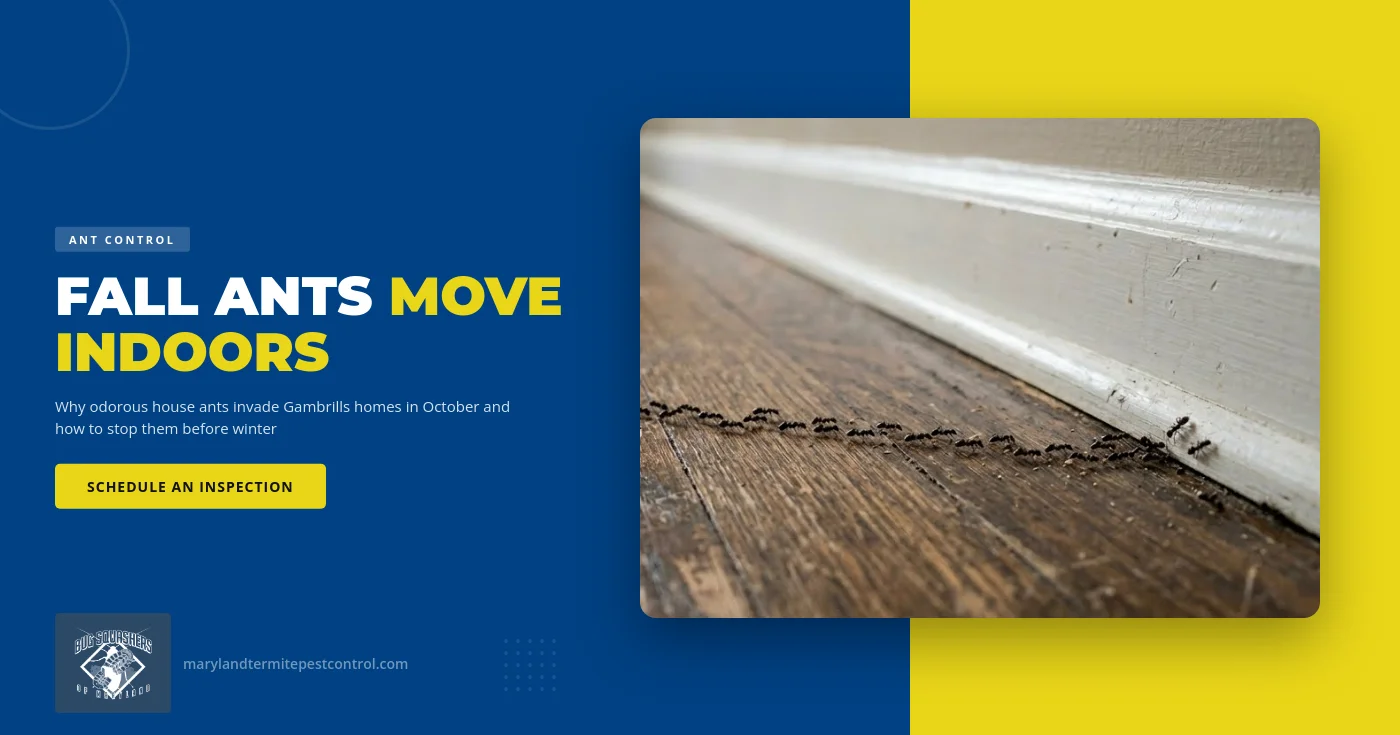
You wipe the kitchen counter, turn around, and there they are again: a thin, busy line of tiny dark ants running from the baseboard to the sugar bowl. If that sounds familiar this month, you’re far from alone. Every autumn we hear from homeowners who are surprised to find ants in the house in fall, just when they expected bugs to be winding down. That surprise is exactly why timely fall ant control in Gambrills matters so much.
The culprit is usually the odorous house ant, a native species that thrives across Maryland and has a real talent for slipping indoors as the weather turns. Here at Bug Squashers, we see the same pattern every year across Anne Arundel County: cool nights, a few rainy days, and suddenly kitchens and bathrooms are full of trails.
In this post, we’ll explain why these ants move inside in October, how to identify them, where their trails usually start, why store-bought sprays often backfire, how professional treatment reaches the colony, and what you can do to seal your home before the first hard frost.
Odorous house ants spend most of the warm season outdoors, nesting under mulch, stones, landscape timbers and leaf litter. Their favorite food is honeydew, the sugary liquid produced by aphids and scale insects feeding on shrubs and trees. As fall arrives, several things change at once.
As plants slow down and aphid populations drop, the honeydew supply shrinks. A colony that may hold thousands of workers still needs to eat, so scouts go looking for new sources. Your pantry, pet bowls and the crumbs under the toaster are an easy win.
In central Maryland, October days often feel mild while nights dip noticeably colder. That contrast pushes ants toward the warmth of foundations, kitchens and bathrooms. Odorous house ants are also well known for moving indoors after heavy rain, which can flood their shallow outdoor nests. A stretch of wet fall weather often lines up with a sudden indoor trail.
We want to be clear: October isn’t a magic date. Ants respond to conditions rather than the calendar, so one year the push might start in late September and another year it might come in November. Still, mid-fall is when we hear about it most often, which makes it a smart time to act.
Odorous house ants are small, roughly 1/16 to 1/8 inch long, and brown to black. Their most famous trait is the smell. Crush one and you’ll notice an odor many people describe as rotten coconut or blue cheese. If you’ve ever wondered what it means when ants smell like rotten coconut, that’s your answer: you’re almost certainly dealing with odorous house ants. University and extension fact sheets on the odorous house ant are a helpful reference for more detail.
Pavement ants are similar in size, but they have two small bumps, called nodes, on their narrow waist, plus fine grooves on the head. Odorous house ants have a single flat node that’s hidden under the abdomen when you look from above. Pavement ants also tend to push little piles of soil out of cracks in sidewalks and slabs.
Carpenter ants are much bigger, usually about 1/4 to 1/2 inch. They don’t eat wood, but they excavate it to nest, sometimes leaving sawdust-like debris called frass near windows, doors or damp framing. Because carpenter ants can damage wood, getting the identification right matters. If you’re seeing large black ants and small piles of wood shavings, call us rather than treating it like an ordinary sugar-ant problem.
Many homes here sit in neighborhoods with generous mulch beds right against the foundation, plenty of ornamental shrubs and a mix of slab and crawlspace construction. That landscaping looks great, but it also creates ideal conditions for ants: moisture, shelter and aphid-covered plants close to the house.
Common starting points we find during inspections include:
Once inside, these ants often nest close to warmth and moisture. Watch for trails near dishwashers, sinks, water heaters, bathroom vanities and behind kitchen baseboards. A trail that disappears into an outlet or a gap in the trim usually means indoor ant colonies have settled into a wall void.
Tip: Follow the trail before you wipe it away. Seeing where the ants come from and where they go gives you, and us, the best clues about the nest. A quick photo or two helps a lot during an inspection.
It’s natural to reach for a can of spray. Unfortunately, with odorous house ants, that quick fix often backfires.
The ants you see are only a small fraction of the colony. The queens stay tucked away in the nest, and odorous house ant colonies can have many of them. Repellent sprays kill the foragers they touch, but the queens keep laying eggs, and new workers soon replace the ones you lost.
When stressed, odorous house ants can “bud,” meaning a queen and a group of workers leave to start a new colony nearby. A heavy spray along a trail may scatter one colony into several smaller nests, sometimes in different rooms. That’s why some homeowners tell us spraying made things worse. It may well have.
Extension and pest management guidance generally favors slow-acting baits for this species. Workers feed on the bait and carry it back to share with the nest, including the queens. The University of Maryland Extension offers useful home and garden guidance on household ants. Keep in mind that baits often take several days to a couple of weeks to show full results, and spraying near bait placements can undo their work.
Working with an ant exterminator Gambrills families can rely on isn’t about stronger products. It’s about strategy. Here’s how we approach it at Bug Squashers:
This colony-focused approach is what we consider the best ant treatment before winter in this part of Maryland, because it addresses the nest rather than just the trail. Ants are also rarely the only pest looking for a winter home. During fall visits we often spot signs of other invaders, so we can pair ant work with our rodent control or cockroach pest control services when needed.
The first frost in this area typically arrives somewhere around late October to early November, though the exact timing varies from year to year. Either way, the weeks before it are your best window to make your home less inviting.
These steps help for the long term, but they won’t remove a colony that has already moved into your walls. If trails keep showing up after a week or two of good housekeeping, it’s time for a professional look.
Shrinking outdoor food, cooler nights and fall rain all push odorous house ants toward the warmth, moisture and easy food inside your home. The timing feels backwards, but it’s a very common fall pattern.
They don’t sting and aren’t considered a structural threat, but they do get into food and can contaminate counters and pantry items. Their sheer numbers are what make them such a nuisance.
Yes. Heated wall voids, spaces near water heaters and areas around plumbing give them a comfortable place to stay active through winter. That’s why treating the colony in fall is so important.
Outdoor activity slows in the cold, but colonies that have moved indoors often keep going. Without treatment, they’re likely to be back on your counters as soon as spring arrives, if they ever leave.
Keep mulch pulled back, shrubs trimmed and gaps sealed, and consider ongoing service. Here at Bug Squashers, we can set up a seasonal plan that keeps an eye on activity before it turns into a trail.
Odorous house ants are persistent, but they’re very manageable when you target the colony instead of the trail. The sooner you act, the fewer nests have a chance to settle in for winter. If you’re seeing ants in your kitchen or bathroom, contact us to schedule an inspection and let us handle fall ant control in Gambrills while there’s still time before the cold sets in.
We proudly serve homeowners in Hanover, Odenton, Crofton, Millersville, Severn, Glen Burnie and communities throughout Anne Arundel and Howard counties. Our neighbors count on us for straightforward advice and thorough work, and we’d be glad to bring that same care to your home and your peace of mind this fall.
When the nights turn cool and fall rain soaks the yard, odorous house ants start looking for warmth, water and food, and our kitchens and bathrooms are right at the top of their list. We hear from homeowners every autumn who are surprised to see trails just as the season winds down. The good news is that these ants are very manageable when you go after the colony instead of the trail.
Here’s how we tackle fall ant problems:
We also recommend skipping store-bought sprays. They kill the ants you see but can scatter a colony into several new nests, which often makes the problem harder to solve. A patient, targeted plan works better and gives you real peace of mind heading into winter.
Want the full picture on why odorous house ants move indoors in October, how to identify them and what you can do to seal your home before the first frost? Read our complete guide to fall odorous house ants, then reach out when you’re ready for us to take a look.