
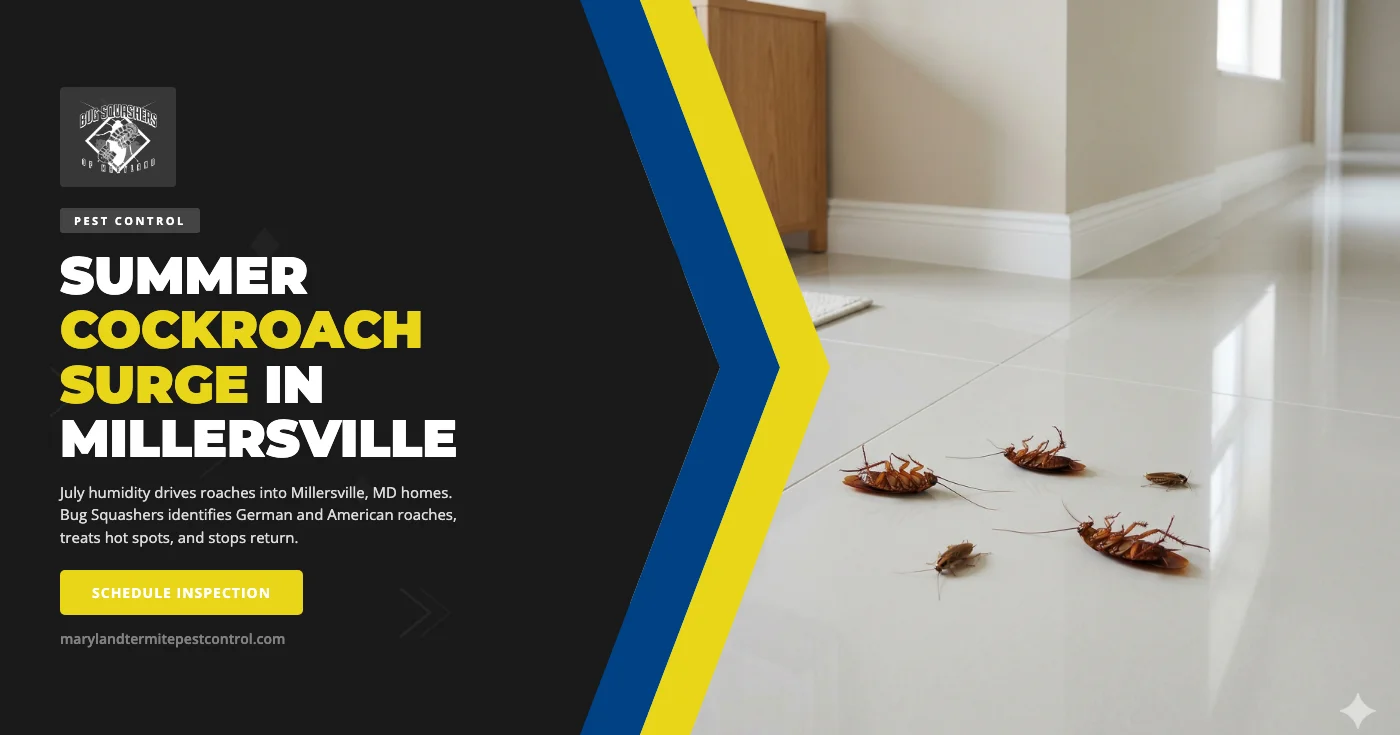
If you live in Millersville, MD and you've started seeing cockroaches in your kitchen, bathroom, or basement over the last few weeks, you're not imagining a sudden surge — you're watching a real seasonal pattern unfold. July is the peak month for cockroach activity throughout Anne Arundel County. The combination of high heat, sustained humidity, and afternoon thunderstorms creates conditions that push cockroach populations to their annual maximum, both outdoors and inside Millersville homes.
At Bug Squashers, we provide professional cockroach control in Millersville, MD and throughout Anne Arundel County. We know which species are showing up in local homes right now, why they're multiplying faster than at any other time of year, and what it actually takes to eliminate an active infestation — not just push it out of sight for a few weeks.
Cockroach biology and Maryland's summer climate are almost perfectly matched, and July is when that match peaks. Cockroaches prefer temperatures in the 85 to 95°F range with humidity around 90 to 95 percent — which could be pulled straight from the Millersville forecast during the first two weeks of July.
Warm temperatures speed up the entire cockroach life cycle. Eggs hatch faster, nymphs mature sooner, and females produce egg cases more frequently. A German cockroach population that would take months to build during cooler weather can multiply through several overlapping generations in a single humid Maryland summer, and a small population can escalate into a visible infestation surprisingly quickly.
Humidity matters even more than heat. Cockroaches lose moisture rapidly through their exoskeleton and can't survive long without access to water. Maryland's humid summer air keeps them hydrated even when they're not actively drinking, letting them remain active longer and forage more aggressively in kitchens and bathrooms.
Afternoon thunderstorms play a direct role in indoor sightings too. Heavy rain floods storm drains, sewers, mulch beds, and crawl spaces where American cockroaches typically live. When their outdoor harborage sites saturate, they push toward drier, warmer refuges — often the interior of nearby homes through foundation gaps, utility penetrations, garage doors, and basement window wells.
Not every cockroach sighting means the same thing. The two species we see most often in Millersville homes are the German cockroach and the American cockroach, and they behave very differently. Correctly identifying which species is present is the first step in choosing the right treatment strategy.
German cockroach (Blattella germanica) — This is the small tan-to-light-brown cockroach with two dark stripes running lengthwise behind the head. Adults are only about half an inch long. The German cockroach is the most common indoor pest cockroach in Maryland and the most difficult to eliminate. Females carry an egg case containing around 40 eggs, and a single German cockroach population can produce up to six generations in a single year. This species lives indoors year-round and prefers warm, humid spaces near food — which means kitchens, pantries, and bathrooms in Millersville homes.
American cockroach (Periplaneta americana) — This is the large reddish-brown cockroach, often an inch and a half or longer, that shows up occasionally in basements, garages, and crawl spaces during humid weather. Sometimes called a "palmetto bug" or "water bug," the American cockroach is primarily an outdoor species that lives in storm drains, sewers, mulch, wood piles, and damp soil around foundations. It's less of an established indoor breeder than the German cockroach, but summer storms drive it indoors in significant numbers throughout Anne Arundel County.
Anne Arundel County homeowners also occasionally encounter the Oriental cockroach — a dark, glossy species that thrives around damp basement drains — and the brown-banded cockroach, which prefers warm, dry spaces higher up in the home. But German and American cockroaches account for the majority of the calls we take in Millersville during July.
Knowing where cockroaches actually live in a Millersville home helps homeowners target their inspection efforts — and helps our technicians focus treatment on the areas where it will make the biggest difference.
Kitchens — This is the number one hot spot for German cockroach activity. Cockroaches harbor in the small, dark, warm gaps around and inside kitchen equipment: behind and under the refrigerator (near the compressor, which stays warm and provides condensation), under the dishwasher, inside the motor housing of the stove, behind the toe kicks of cabinets, in the hinges of cabinet doors, and inside the space around plumbing penetrations under the sink. Cardboard boxes and paper grocery bags stored in the pantry are frequent hiding spots as well — and often the original point of entry.
Bathrooms — Bathrooms provide the moisture cockroaches need, and they typically stay warm year-round. German cockroaches hide behind toilets, inside vanity cabinets, around tub plumbing access panels, and in the gaps behind bathroom outlets and light switches. Any bathroom with a small leak, a loose trap, or persistent condensation is significantly more attractive to cockroaches than one that stays dry.
Basements and utility rooms — American cockroaches, Oriental cockroaches, and occasionally German cockroaches harbor in basements with floor drains, sump pumps, utility sinks, and access to the exterior through crawl spaces or foundation vents. Water heaters and furnace areas provide constant warmth even during winter and often serve as year-round harborage sites for cockroach populations.
Behind appliances and inside walls — Wall voids, kick plates, and the spaces around plumbing and electrical penetrations connect all of these areas into one continuous highway. Cockroaches move between rooms, floors, and even between adjacent units in townhomes and condominiums through these hidden pathways — which is why treatment that focuses only on the surfaces you can see rarely resolves a real infestation.
Cockroaches aren't just an unpleasant sight — they carry meaningful health risks, particularly in homes with children, elderly residents, or anyone with respiratory conditions. Cockroach infestations are recognized by the CDC and public health researchers as a significant indoor allergen source, and the connection to childhood asthma is well documented.
Cockroaches shed their exoskeletons multiple times as they grow, and both the shed skins and their feces contain proteins that trigger allergic reactions and asthma attacks. In homes with active infestations, these allergens accumulate in dust and become airborne, particularly in kitchens and living areas. Children in homes with cockroach infestations are at meaningfully higher risk of developing asthma symptoms and of having existing asthma worsen.
Cockroaches also carry pathogens on their bodies and in their digestive tracts. As they move between garbage, drains, pet food bowls, and food preparation surfaces, they can transfer bacteria including strains of Salmonella and E. coli, along with organisms that cause dysentery, gastroenteritis, and other digestive illnesses. This is why finding cockroaches inside a food storage area is a genuine sanitation concern, not just an aesthetic one.
For families in Millersville with young children or a family member managing asthma, allergies, or a compromised immune system, controlling a cockroach infestation quickly is a matter of household well-being and peace of mind, not just pest management.
Almost every homeowner we work with in Millersville has tried an over-the-counter cockroach product before calling us — often several different products. There's nothing wrong with attempting a first-line response, but understanding why retail solutions rarely work on real infestations helps explain what a professional approach does differently.
Contact sprays kill the individual cockroaches they touch, but they don't reach the harborage areas where the actual population lives. For every cockroach you see in the open, dozens more — plus egg cases containing 40 or more future roaches each — are hidden in wall voids, appliance interiors, and cabinet framing where sprays can't reach. Killing the visible foragers has almost no effect on the reproductive core of the population.
Worse, aggressive sprays often trigger cockroaches to move deeper into hiding, spread into adjacent rooms, or split into satellite populations. What looks like initial success — fewer roaches on counters — is sometimes the population dispersing rather than dying. Homeowners then find cockroaches showing up in new areas of the home a few weeks later.
Consumer bait products can be more effective than sprays because cockroaches carry the bait back to the harborage and share it through their droppings and feeding behavior. But bait effectiveness depends heavily on correct placement, bait rotation to avoid resistance, and sufficient bait volume relative to population size. A few bait stations placed in visible spots rarely reach the numbers needed for an established German cockroach infestation.
Foggers and bug bombs are the least effective option for cockroaches. They don't penetrate harborage areas, they push cockroaches deeper into wall voids, and they leave residue on food-preparation surfaces where it's neither useful nor welcome.
Professional cockroach control in Millersville works because it treats the population instead of the individual insects — and because it addresses the conditions that allowed the infestation to develop in the first place. When you call Bug Squashers about a cockroach problem, we follow a process designed around cockroach biology and the layout of Anne Arundel County homes.
We start with a thorough inspection. Correctly identifying the species tells us where the population is likely harboring, how large it might be, and which treatment approach will be most effective. We use flashlights, mirrors, and monitors to locate harborage sites behind appliances, inside cabinet framing, around plumbing penetrations, in basement utility areas, and along the exterior foundation. The inspection typically uncovers activity in places most homeowners never think to look.
Our treatment combines several approaches so that the population is hit from multiple directions at once. Targeted professional baits placed directly at harborage sites deliver active ingredient to the interior of the population, where it spreads through feeding and grooming behavior. Insect growth regulators disrupt the development of nymphs and prevent egg cases from producing viable next-generation cockroaches. Where appropriate, dust formulations reach into wall voids and framing gaps that liquids and baits can't access. Every product we use is professional-grade and applied where cockroaches actually live, not broadcast across surfaces where children and pets spend time.
We also address entry points and conducive conditions. Sealing gaps around plumbing and utility penetrations, adjusting door sweeps, addressing moisture issues, and identifying grocery-bag or cardboard-based entry pathways cuts off the routes new cockroaches use to re-establish themselves. Elimination alone isn't sustainable without addressing why the population was able to build up in the first place.
Follow-up visits confirm that the treatment worked, address any surviving nymphs from egg cases that hatched after the initial visit, and prevent a resurgence during the remaining weeks of high summer activity. For persistent or heavy infestations, ongoing service keeps cockroach pressure suppressed through the rest of the year.
If you're seeing cockroaches in your Millersville kitchen or bathroom this July — even just one or two — the population you can see is almost never the whole picture. Egg cases, hidden nymphs, and harborage-based adults typically outnumber visible foragers by a wide margin, and July's heat and humidity give the population its fastest possible growth conditions. Waiting rarely helps.
Bug Squashers serves Millersville and communities throughout Anne Arundel County with professional cockroach control designed for Maryland's summer conditions and the species we actually encounter here. We identify what's present, treat the harborage areas where it lives, address the entry points and moisture conditions that supported the infestation, and follow through until the population is genuinely gone.
Contact us to schedule a cockroach control inspection for your Millersville or Anne Arundel County home. We'll identify the species, assess the extent of the activity, and outline a treatment approach that fits your home and your family.