
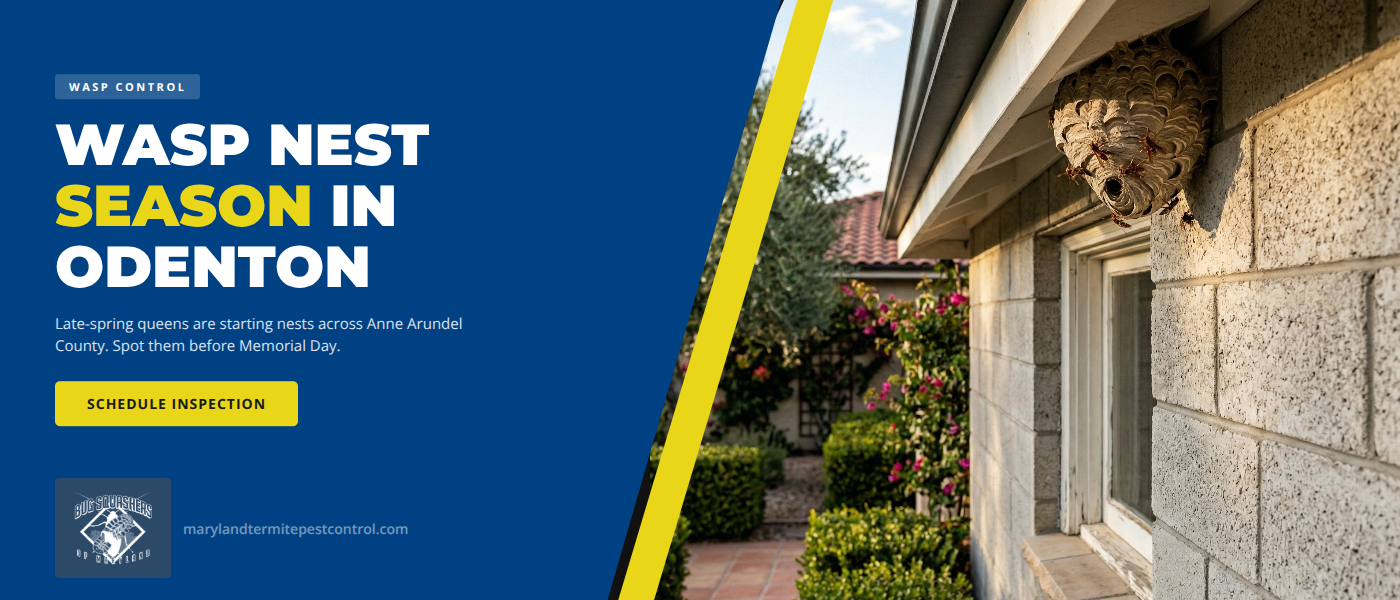
Late May in Odenton is when the calls start coming in — "There's a paper-thin wasp nest under our deck rail, and we have a cookout Saturday." Queens that overwintered in attics, sheds, and wood piles across Anne Arundel County are out by Mother's Day, founding new colonies before the warm weather settles in. At Bug Squashers, we see wasp control odenton md service requests climb sharply between the last week of April and Memorial Day, and the pattern is the same every year: small early nests that go unnoticed until a homeowner is already within stinging range.
The good news for Odenton families is that late-spring nests are still small, single-queen operations — usually fewer than a dozen workers and easy to resolve before Memorial Day cookouts begin. The wasp control odenton md homeowners need this time of year is mostly about knowing where to look and when DIY stops being a reasonable plan.
Most Maryland wasps follow an annual cycle. Only fertilized queens survive winter, riding out the cold in attic insulation, soffit voids, leaf litter, and woodpiles. Once daytime temperatures hold above 60°F — typically the second or third week of April — those queens emerge and begin scouting nest sites. By late May, the founding queen has built a starter nest and is raising the first workers that will take over construction.
Three patterns push wasp activity up across Odenton every spring:
A nest that was the size of a golf ball three weeks ago can be the size of a softball by the weekend a family wants to host its first cookout. Catching it at the golf-ball stage is why we recommend an inspection in the second half of May.
"Wasp" is a catch-all term, and the species you have determines how the wasp control odenton md response should be planned. Across Odenton and the rest of Anne Arundel County, four stinging species drive the majority of our late-spring calls. The University of Maryland Extension's guidance on social wasps and bees describes the same lineup, and each one nests in a distinct place.
Honeybees and bumblebees are a separate matter. We refer Odenton homeowners to a local beekeeper for swarms — fuzzy bodies and pollen-loaded legs almost always mean a bee, not a wasp.
Wasps reuse the same handful of architectural features across Anne Arundel County. When we run a wasp control odenton md inspection, we work through the same sequence in every home, because queens select sites by geometry, not by neighborhood.
Top nest-building spots we check first in late May:
Yellowjackets in particular love a south-facing slope with loose mulch or an abandoned rodent run. If you've been pulling weeds and watched a steady stream of insects exit the same spot in the dirt, mark the spot and call before mowing or weed-eating near it.
Wasps build small in late May, and a starter nest is easy to miss if you don't know what you're looking for. Here's what we tell Odenton families to watch for during pre-Memorial Day yard prep:
If you spot any one of these, the colony is still small enough to resolve in a single visit. Wait two more weeks and the count of workers can quadruple — that's when stinging incidents climb.
Most Odenton sting incidents around Memorial Day happen at the food table, not the nest. A late-spring colony is foraging for protein to feed brood, and a grill or open cooler is a powerful draw. The Centers for Disease Control's guidance on stinging insect exposure notes that allergic reactions can escalate quickly with multiple stings, and that minimizing attractants is the most effective field control during outdoor events.
The routine we walk Odenton families through before a cookout:
For families with a known sting allergy, the bigger move is to confirm there's no nest within 25 feet of the gathering area before the cookout. That's a fifteen-minute walk-around, and it's the highest-value piece of wasp control odenton md prep you can do in May.
Hardware-store wasp sprays are popular for a reason — they're cheap, fast, and the can advertises a long-range jet. They also fail in three predictable ways across the Odenton homes we get called back to.
Penn State Extension's technical guidance on yellowjackets reinforces the point: aerosol products are a partial control at best, and treatment of established colonies requires direct dusting of the nest entrance with a residual product applied at night.
The right time to schedule wasp control odenton md service is the moment you confirm an early nest — not after the first sting. Late May into early June is the window where a single targeted treatment resolves the issue for the rest of the season in most Odenton homes.
Call us when any of these apply:
Our late-spring response: a full exterior inspection covering eaves, soffits, deck framing, sheds, and ground perimeter; species identification on every active nest; targeted treatment with a residual product appropriate to the species and location; and a re-inspection two to three weeks later. Most Odenton properties clear after a single visit when caught in May. Contact Bug Squashers to schedule an inspection.
How can I tell if a wasp nest is still active?
Observe from at least 20 feet during daylight. If you see steady traffic of workers entering and exiting through the day, treat the nest as active and call before getting any closer.
Are paper wasps more aggressive than yellowjackets?
Generally no. Paper wasps are defensive within a few feet of their nest but rarely chase. Yellowjackets are more aggressive at greater distances and drive most of the sting incidents we see during late-spring landscaping work in Odenton.
Is it ever a good idea to knock down a wasp nest myself?
We don't recommend it. Aerosol products often produce a partial knockdown that drives surviving workers more defensive, and ladder falls are the leading reason Anne Arundel County homeowners end up in urgent care after a DIY attempt.
Will the wasps come back to the same spot next year?
Often, yes. Queens select nest sites by geometry, and a spot that worked last year is likely to be chosen again. We document every treated location so we can revisit those exact sites during the next spring inspection.
What if I'm allergic to stings and I think there's a nest near my door?
Don't approach it. Call us, describe the location, and we'll prioritize the visit — a same-week response is standard for households with a known sting allergy.