
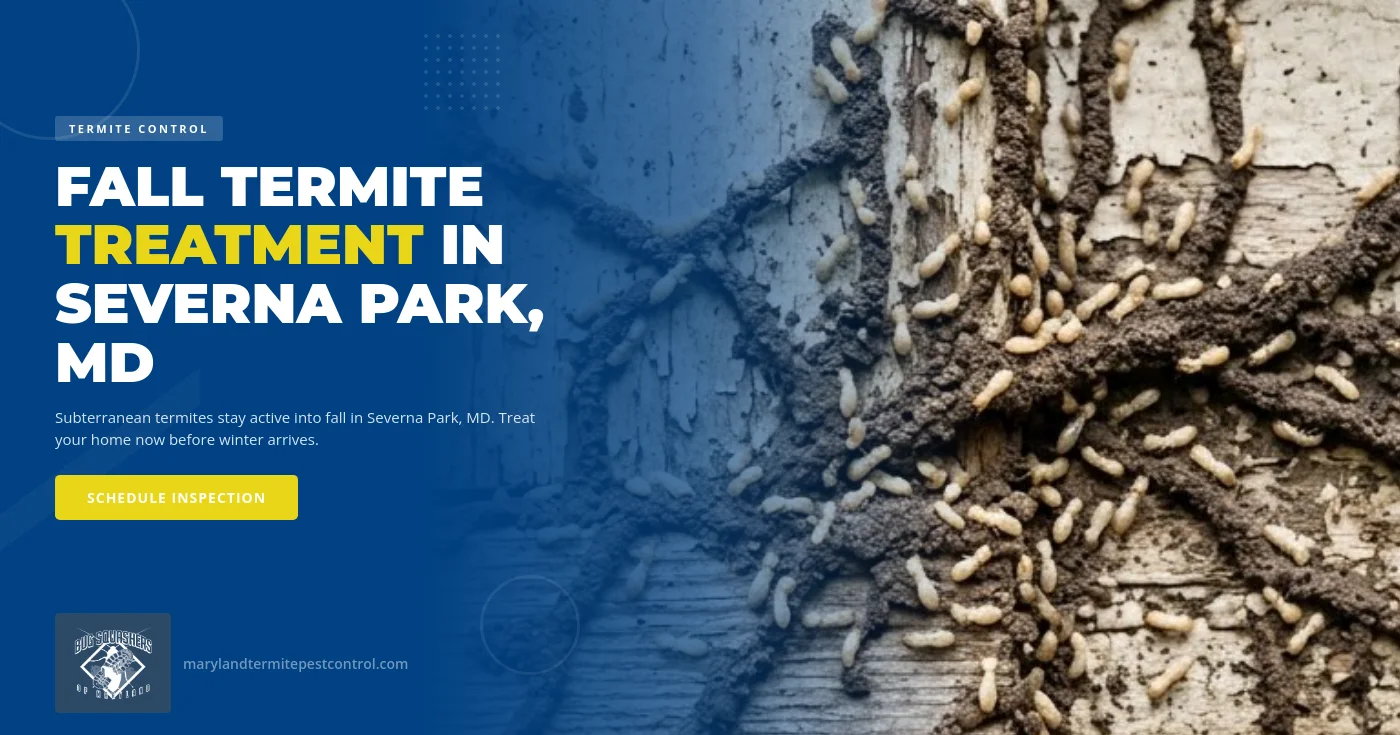
Most Severna Park homeowners assume termite season ends with the first chill of October. The calls into Bug Squashers tell a different story. Through October and well into November, we find active subterranean termite workers chewing through sill plates, floor joists, and basement framing in homes across Anne Arundel County. Waiting until next year is how a localized problem becomes structural termite damage severna park homeowners pay tens of thousands of dollars to repair. The termite treatment severna park md families need this fall is about intercepting an active colony before it drops below frost line and resumes next March.
The dominant termite species across Anne Arundel County is Reticulitermes flavipes, the eastern subterranean termite. Unlike the swarmers homeowners sometimes see in April and May, the worker caste that actually damages wood operates year-round. Workers are blind and soft-bodied, so they travel through mud tubes they build along foundations, sill plates, and the gaps between masonry and wood. Those tubes stay humid enough for the colony to feed through temperature swings that would kill any individual termite exposed on open soil.
The critical thermal minimum for R. flavipes workers is between 42°F and 46°F — a range Severna Park soil temperatures sit above through most of October and into early November. As overnight air temperatures drop into the forties, the colony's foraging simply shifts: surface activity declines, but workers in sill plates, wall voids, and soil-contact wood keep eating. Only when deep-soil temperatures fall into the mid-thirties do the main colony chambers retreat below frost line — depths recent research tracks to forty inches or more.
What this means for subterranean termites anne arundel county property owners is simple: a colony discovered in October has already fed through a full summer and will overwinter at the bottom of its gallery system, waiting for spring. The physical damage done to your home does not heal.
Subterranean termites do everything inside the wood. Visible signs on the outside of a board are late indicators, which is why so many Severna Park infestations get discovered during a renovation or home sale rather than by the homeowner. Fall is the right time to walk your home for the handful of signals that give an active colony away.
Mud tubes on foundation walls. Pencil-width tubes of packed soil running vertically up a concrete foundation, brick veneer, or basement wall are the signature sign of an active colony. Fresh tubes are damp and darker; abandoned tubes crumble between your fingers.
Hollow-sounding wood. Tap along baseboards, door jambs, window sills, and exposed basement framing with a screwdriver handle. Wood with an active termite gallery produces a dull, hollow tone compared with sound framing a few inches away.
Blistered or warped paint on interior trim. As workers eat through the back of a baseboard or window casing, the paper-thin surface left behind can bubble, split, or appear waterlogged even where there is no plumbing leak.
Discarded wings near windows and door frames. Fall swarmers from the light southeastern subterranean termite drop their wings after short flights, leaving translucent wings on sills or around basement doors. Finding wings inside the home is a reliable indicator of a nearby or interior colony.
Frass is not a subterranean termite sign. Pellet-like droppings belong to drywood termites — a species not established in Maryland. Any company that identifies "termite frass" during a Severna Park inspection has misidentified the species, and the treatment plan will be wrong.
A fall termite inspection maryland families book with our team starts with a methodical crawl of the basement, crawl space, sill plate, and exterior foundation looking for exactly these indicators — plus the moisture and conducive-condition factors that let the colony move in.
Severna Park sits on a peninsula bounded by the Severn River to the south and the Magothy to the north, with the Chesapeake Bay a few miles east. Groundwater runs high. Yards slope toward the water. Summer and fall humidity sits above seventy percent for weeks at a stretch. The result is a soil moisture profile that keeps subterranean termite colonies thriving far longer into fall than at inland Maryland sites.
Three structural features drive the risk pattern we see across the peninsula. First, foundation moisture at grade. Many homes built in Severna Park through the 1960s and 1970s have cinder-block foundations that wick groundwater upward, keeping sill plates and rim joists damp enough for workers to find and establish a feeding route.
Second, landscape drainage. Downspouts emptying against the foundation, mulch beds built up over the sill line, air-conditioning condensate puddling at the slab, and poorly graded garden beds all concentrate moisture where R. flavipes colonies most want to establish mud tubes. On our fall termite control severna park maryland inspections, moisture-concentrating landscape features show up on nearly every active-infestation report.
Third, crawl-space conditions. Unencapsulated crawl spaces along the peninsula frequently run at eighty-plus percent relative humidity through fall, with condensation on sub-floor insulation. That environment lets workers forage further from the main gallery without drying out.
Reducing the moisture signature your home projects is one of the best long-term termite deterrents available, and our fall assessment flags every one of these conditions in a written moisture report.
Homeowners often assume treatment is reactive — something you do after finding damage. Our experience across Anne Arundel County is the opposite. Fall is the single best window for proactive subterranean termite treatment, for three reasons.
First, the colony's position is predictable. From late September through early November, workers are still foraging in and near sill plates and foundations rather than deep in the soil, which means bait stations and liquid barriers reach the active population directly. A perimeter treatment installed in October intercepts the colony while it is actively feeding; the same termite treatment severna park md families install in January works against workers already clustered below frost line and takes an extra season to show effect.
Second, fall treatment gets ahead of the spring swarm. The reproductive caste that produces alates spends the winter developing in the main gallery system. A liquid termiticide barrier or a complete bait station network installed in October works through the entire winter, so by the time swarmers would emerge in April or May, the colony is weakening or already collapsed.
Third, the moisture conditions that let subterranean termites thrive in a Severna Park yard are visible in fall. Our technicians can identify every downspout outflow, every mulch overbuild at the foundation, and every crawl-space moisture issue while leaves are still on the trees and the ground unfrozen. Correcting those conditions as part of the treatment plan is what prevents the next colony from establishing after the current one is eliminated.
Not every termite job needs the same approach. Our team walks the property, confirms the species, maps mud tubes and conducive conditions, and recommends from two primary strategies we routinely combine for Severna Park homes.
Non-repellent liquid termiticide barrier. A trenched or injected treatment of the soil adjacent to the foundation establishes a continuous chemical zone that workers cannot detect and do not avoid. The active ingredient is slow-acting and transferable among nestmates, so workers carry it back to the main gallery, which collapses the colony over several weeks. Non-repellent chemistry has been the gold standard for subterranean termite elimination in the Mid-Atlantic for more than a decade.
In-ground bait station network. Stations installed every ten to fifteen feet around the exterior perimeter contain a cellulose matrix impregnated with an insect growth regulator. Foraging termites discover the stations, feed, and carry the bait back to the colony. Over a three-to-six-month cycle, the colony loses the ability to molt — new workers can't develop — and the population collapses. Bait stations are preferred for homes with strong conducive conditions but no active infestation yet, and for homes where construction makes liquid trenching impractical.
Direct-wood treatment. Where we find active galleries inside accessible wood — a sill plate, basement joist, or crawl-space post — we drill small application ports and inject a residual termiticide foam directly into the gallery system. This supplements the perimeter treatment and knocks down the resident worker population immediately.
Moisture and exclusion correction. Every treatment includes a written list of conducive-condition corrections — downspout extensions, mulch pullback, crawl-space ventilation improvements, grade adjustments at the foundation — because a treated home that still projects a strong moisture signature invites the next colony within a few years.
Subterranean termite colonies in Maryland do not go away on their own. A mature R. flavipes colony can contain hundreds of thousands of workers and consume more than a pound of wood per year — a modest-sounding number until you realize that pound is coming out of the structural lumber holding up your home.
Deferred treatment compounds in three ways. The physical damage grows: every month of feeding is more gallery, more hollowed sill plate, and more compromised framing. The repair scope grows: a sill plate replaced early is a half-day carpentry job; replaced after three years of undetected feeding, it often involves jacking the structure, resetting floor framing, and in bad cases rebuilding sections of load-bearing wall. And the chemistry becomes less effective — a mature colony with multiple satellite feeding sites is harder to collapse in one treatment cycle than a young colony with a tight gallery system.
Most homeowners insurance policies treat subterranean termite damage as a maintenance issue, not a covered peril. Homeowners who defer treatment carry the full cost of repair when the damage is discovered — most often during a home sale, when the inspector catches what the owner missed. We see that scenario on real-estate transactions across Anne Arundel County every month.
Scheduling a fall inspection confirms whether an active colony is present and, if one is, puts a treatment in place before the colony drops below frost line and the opportunity passes until spring.
Our Severna Park termite program has two parts: an initial treatment matched to what we find on the property, and an ongoing monitoring and renewal plan that keeps the home protected through subsequent seasons.
The initial visit covers the full exterior perimeter, the basement or crawl space, the sill plate and rim joist system, and any wood-to-soil contact points — porch posts, deck ledgers, buried landscape timbers. We identify the species, map existing galleries and mud tubes, and recommend the treatment combination that fits the structure. Installation is typically a one-day job on most Severna Park homes.
Ongoing monitoring is where long-term protection comes from. In-ground bait stations get checked quarterly; any station with activity triggers re-baiting and a full re-inspection. Liquid barriers get renewed on the manufacturer's recommended cycle. Every monitoring visit is a fresh set of eyes on conducive conditions — a new downspout outflow, a mulch bed that grew back up over the sill, a dripping hose bib — so small changes get corrected before they let a new colony establish.
Our team is local to Anne Arundel County, which means our technicians know the neighborhoods on the Severna Park peninsula — Round Bay, Linstead, Chartwell, Olde Severna Park, Ben Oaks — and the soil, drainage, and construction patterns that drive termite pressure in each.
If you have seen mud tubes, winged termites around a window, or hollow-sounding trim in your Severna Park home — or if your home has not had a termite inspection in the last three years — contact Bug Squashers to schedule your fall inspection before the colony drops below frost line and the window closes until spring.
If you have seen mud tubes on your foundation, hollow-sounding baseboards, blistered trim paint, or discarded wings on a sill this fall, the colony is almost certainly still foraging in and near your home — and waiting until spring will give it another winter to feed uninterrupted. Our team runs a structured fall termite protocol: full exterior perimeter walk, basement and crawl-space inspection, species identification, mud tube and gallery mapping, moisture and conducive-condition assessment, and a written treatment plan matched to what we find on the property.
What a Severna Park homeowner should do this week:
For any home with confirmed mud tubes, hollow framing, or interior swarmer wings — or any Severna Park home that has not had a termite inspection in the last three years — our team can be on site this week with a full treatment plan ready for discussion. Learn more about our termite treatment program or contact Bug Squashers to schedule your fall inspection before the window closes.