
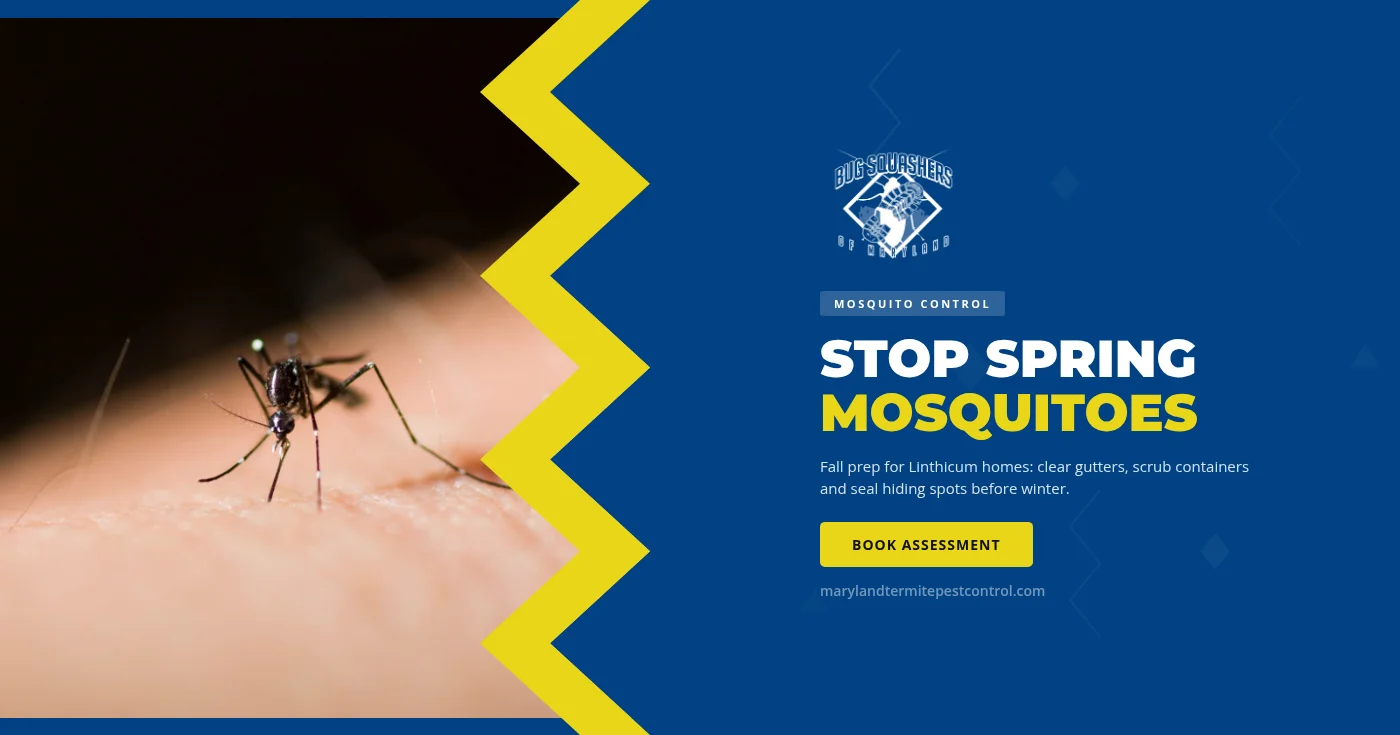
When the maples along Linthicum’s streets start dropping leaves, most of us stop thinking about mosquitoes. That’s exactly when fall mosquito prevention does its best work. The mosquitoes that bite you next May aren’t flying in from far away. Many are already tucked into a garage corner, a crawl space or a gutter full of wet leaves, waiting out the cold on your property.
Here at Bug Squashers, we’ve helped homeowners across Anne Arundel County with pest problems since 2017. Every November we see the same pattern: yards that get a thorough fall cleanup have noticeably quieter springs. Linthicum’s mature trees, older homes with crawl spaces and detached garages, and its humid spot near the Patapsco River give overwintering mosquitoes plenty of places to wait.
In this guide, we’ll cover where mosquitoes hide in winter, how their eggs survive the cold, a practical November yard checklist, how to seal up your home, and how to plan spring service before the season starts.
November in Linthicum is an in-between month for mosquitoes. Leaf fall peaks, yet plenty of afternoons still reach the 60s, and on those days you may notice a few stragglers near the back door. Hard freezes in the Baltimore–BWI area usually arrive sometime in early to mid-November, though the timing shifts from year to year. Once cold settles in, the adults that survive head for shelter, and eggs laid in late summer go dormant.
That’s why fall mosquito prevention looks different from summer treatment. Spraying for adult mosquitoes in November generally isn’t useful. There aren’t enough active adults to target, and the ones that matter are hidden. The work this time of year comes down to two things: removing the places where eggs wait out winter, and closing off the sheltered spots where adults hibernate.
Your own yard matters more than you might think. The Asian tiger mosquito, the aggressive daytime biter most of us know from summer cookouts, typically travels only a few hundred yards in its lifetime, based on University of Maryland Extension guidance. In practical terms, the mosquitoes biting you in June were most likely raised on your property or a neighbor’s. Clean up those breeding spots now, and you shrink the starting population before the first warm spring rain. It’s the most cost-effective step in good mosquito season planning, and it usually takes only an afternoon or two.
Not every species handles winter the same way. Some die off and leave eggs behind; others survive the cold as adults. Knowing the difference tells you where to focus.
The northern house mosquito (Culex pipiens) is the main overwintering adult in our area. According to the Centers for Disease Control and Prevention, Culex mosquitoes are also a primary carrier of West Nile virus. Mated females spend the winter in protected, unheated spaces: garage corners, crawl spaces, basements, sheds and wood piles. When spring brings a run of warm days, they emerge already fertilized and ready to lay their first eggs, which gives them a head start on the season.
Older Linthicum homes with vented crawl spaces and detached garages suit these overwintering mosquitoes well. Gaps around garage doors, open foundation vents and cluttered sheds all offer the still, humid air they look for.
Storm drains, culverts and drainage pipes stay a few degrees warmer than the open air, hold moisture and block the wind. Storm drains on public streets are generally the county’s responsibility, so if one near your home stays clogged with leaves and standing water, it’s worth reporting to the county’s public works department. Private drainage on your lot, such as French drains, buried downspout lines and catch basins, is yours to keep clear.
The Asian tiger mosquito (Aedes albopictus) relies on its eggs instead of hiding as an adult. Females lay them on the inside walls of containers, just above the waterline. Those eggs are cold-hardy and can sit dormant through winter. When spring rain raises the water level and floods them, they hatch. The Maryland Department of Agriculture’s Mosquito Control program points to backyard containers as a major source of these daytime biters.
Here’s the catch: dumping out a bucket doesn’t always remove the eggs. They’re stuck to the surface, so a container that looks empty in November can still produce mosquitoes in May. To deal with mosquito eggs in winter, scrub containers with a stiff brush, dry them and store them upside down or under cover.
Common spots where eggs hide around homes in our area include:
Mosquitoes need very little water to breed; roughly a bottle cap’s worth can be enough. That’s why gutters top our fall checklist.
A solid fall yard cleanup for mosquitoes doesn’t require special equipment. Work through this list after most leaves are down but before the ground freezes.
Clean gutters in fall to keep mosquitoes from finding a winter nursery right above your windows. Remove packed leaves, flush the channels with a hose and make sure downspouts drain freely several feet from the foundation. If a section sags and holds water, adjust the hangers.
Damp leaf piles hold moisture and give adults a sheltered resting spot. Bag them, compost them in a covered bin or set them out for fall yard-waste collection. Check the Anne Arundel County Department of Public Works site for this year’s dates.
Tarps over grills, boats, wood piles and pools sag and collect rainwater. Pull them tight, prop the center so water runs off, or dry them before storing. Bring in tires, toys and buckets.
Walk the yard after a rain. Low spots that stay soggy for days, clogged swales and puddles under downspouts are future breeding sites. Regrade, add soil or extend downspouts, and trim dense shrubs near the house where adults rest.
Once the yard is handled, turn to the structures where hibernating mosquitoes settle in. The goal is to make it hard for adults to reach the still, sheltered spaces they need.
There’s a bonus to this work. The same gaps that let mosquitoes in are open doors for mice and rats looking for warmth this time of year. If you spot droppings, gnaw marks or nesting material while sealing up, our rodent control team can help find and close entry points before winter. A damp crawl space also draws mosquitoes, spiders and other pests, so fixing leaks and improving ventilation pays off well beyond mosquito season.
Fall cleanup lowers the starting population, but it won’t stop every mosquito drifting in from wooded lots, creeks and stormwater ponds nearby. That’s where a planned spring program comes in.
For most homes in our part of the state, the first treatment makes sense somewhere between mid-April and May, once temperatures hold steady. Timing depends on each year’s weather, so we watch conditions rather than pick a fixed date. Booking in late fall or winter puts your property on the schedule before the spring rush.
The state also runs a mosquito control program with Anne Arundel County, generally from about late May through September, where residents can request spraying. Coverage and rules can change, so check with the Maryland Department of Agriculture to confirm whether your street is included. Our service focuses on your property specifically: the shaded resting spots and breeding sites a neighborhood truck can’t reach.
Here at Bug Squashers, we offer multi-service discounts when you bundle treatments, such as seasonal mosquito service with termite protection. Ticks thrive in the same shady, humid areas as mosquitoes, so adding tick control is a natural fit for many families. We currently offer 20% off initial service agreements with a minimum one-year term, plus discounts for military members, teachers, nurses, police and first responders. Referrals earn $25 off when the person you refer signs a service agreement.
It depends on the species. House mosquito females hibernate as adults in garages, crawl spaces, sheds, storm drains and similar sheltered spots. Asian tiger mosquitoes die off as adults and leave cold-hardy eggs in containers, tires, tree holes and gutters.
Many do. Tiger mosquito eggs can stay dormant through a typical winter here and hatch when spring rain floods them. Scrubbing and drying containers in fall is the most reliable way to remove them.
In our experience, yes. Because tiger mosquitoes don’t travel far, removing breeding sites and sealing hiding spots on your property lowers the number that emerge near your home. It won’t stop every mosquito, but it gives spring treatments a smaller population to work against.
Adult mosquito treatments generally aren’t useful this late in the year. November is better spent on cleanup, sealing and scheduling. A walkthrough now can identify the problem areas to target first in spring.
A few hours of fall mosquito prevention, from clearing gutters and scrubbing containers to tightening tarps and sealing garage and crawl space gaps, can mean far fewer bites when warm weather returns. Pair that groundwork with a spring plan, and you’ll be ready before the first swarm shows up.
Bug Squashers has served local homeowners since 2017 from our home base in Hanover, with service throughout Linthicum, Glen Burnie, Severn, Pasadena, Odenton, Elkridge and neighboring communities. We’re licensed in Maryland and know how mosquitoes behave in our neighborhoods. Contact Bug Squashers today to schedule a yard assessment and get on our spring mosquito list early.
We know fall cleanup goes a long way, but most yards still have hidden breeding sites and resting spots that are easy to miss. That’s where our team comes in. When you book a yard assessment with us, we walk your property looking for the places overwintering mosquitoes and their eggs are most likely to be waiting.
For homeowners looking for mosquito control in Linthicum, MD and nearby communities, we offer 20% off initial service agreements with a minimum one-year term. We also extend discounts to military members, teachers, nurses, police and first responders, and our referral program gives you $25 off for every referral who signs a service agreement.
Here at Bug Squashers, we’ve been helping local families take back their yards since 2017. We’re licensed in Maryland, we focus on your property’s specific trouble spots, and we plan ahead so you’re not scrambling once the first warm spell hits. Reach out to us this fall, and we’ll help you start next season with fewer bites and more peace of mind.