
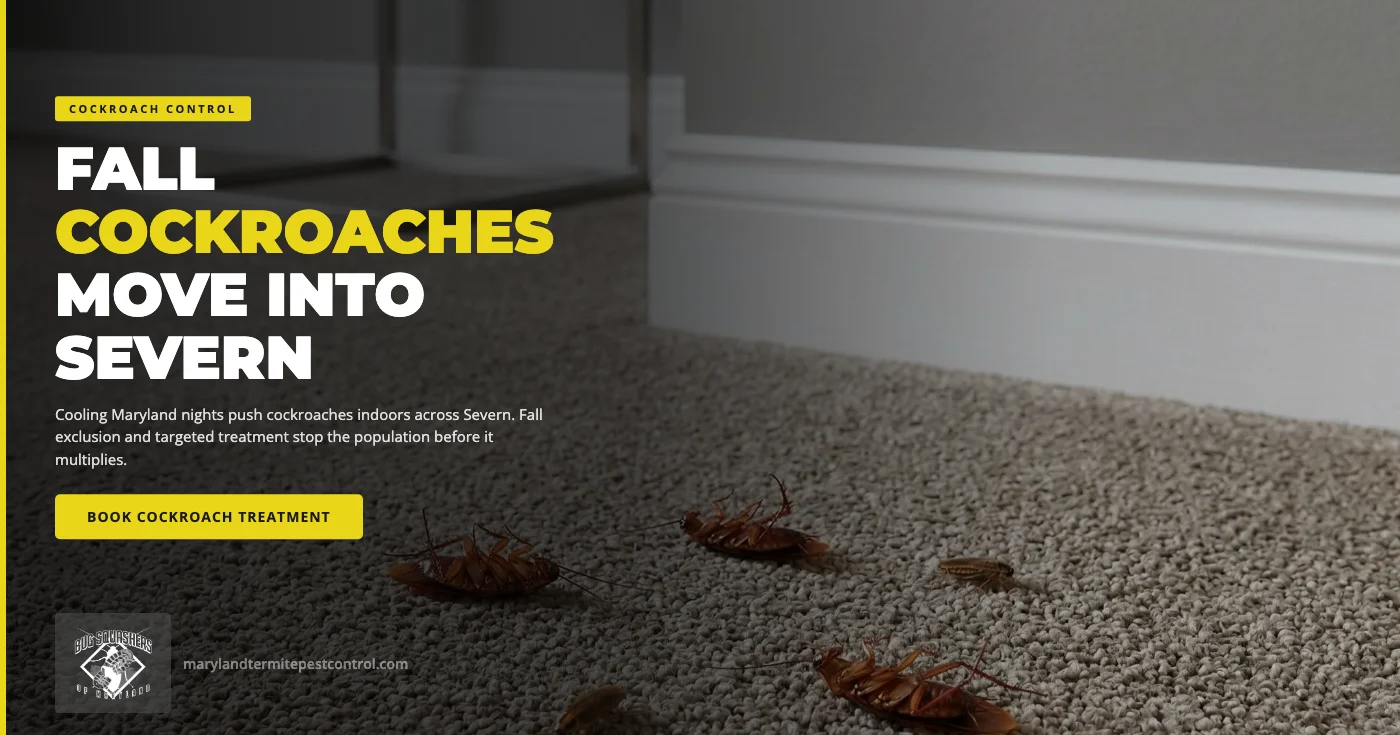
By late September, the cockroach calls into Bug Squashers shift character. Summer humidity spikes taper off, but our phones pick up — a homeowner in Severn who has never seen a cockroach indoors finds one behind the refrigerator, an apartment resident spots one on a counter at 2 a.m., a townhome near Reece Road turns up a cluster in the basement. The cockroach control severn md families need this fall is a different problem from summer roach management. Cool nights don't reduce the pressure — they concentrate it. Roaches that spent summer breeding under mulch, in water meters, and along foundation joints migrate indoors as temperatures drop below their survival threshold. Our cockroach pest control severn md team has worked this corridor through multiple fall seasons.
Cockroaches are ectothermic — cold-blooded — and their body temperature tracks the environment they're standing in. Once outdoor overnight lows drop into the fifties and forties, most cockroach species active in Anne Arundel County can no longer maintain the metabolism they need to feed, reproduce, or forage. The response is migration to the nearest heat source, which in Severn means the crawl spaces, basements, wall voids, and kitchens of every heated home within a few hundred feet of their summer harborage.
This behavioral shift is why fall cockroach infestation severn maryland calls to our office run heaviest between the last week of September and the second week of November. The colonies didn't appear out of nowhere. They were already breeding all summer in mulch beds along the foundation, in outdoor grill covers, under stacked firewood, and in the water meter pits at the property edge. The first sustained stretch of cool nights pushes them across the threshold.
Two additional pressures amplify the shift. Outdoor food sources — decaying leaves, ripe fallen fruit, insect prey — collapse quickly through October. Moisture patterns change too: outdoor puddles freeze at night, but indoor plumbing, dishwasher drip pans, and bathroom traps stay wet year-round. Given a choice between a drying-out mulch bed and a heated crawl space with condensation on the ductwork, an American cockroach makes the same decision every time.
The entry points cockroaches use in fall are not different from summer — the traffic through them is. A gap that saw one or two cockroaches during a July heat wave sees dozens through an October cold snap. We see the same handful of openings on virtually every fall call.
Foundation and sill-plate gaps. Most Severn homes built before 2005 have shrinkage cracks where the concrete foundation meets the sill plate. Anywhere daylight is visible from inside a basement, cockroaches can enter — American cockroaches can fit through openings as narrow as a nickel's thickness.
Utility penetrations. Every point where a phone line, cable, hose bib, gas line, dryer vent, or HVAC condensate line passes through an exterior wall is a candidate entry. Older foam sealants shrink over time, opening a gap a German cockroach walks through without slowing down.
Garage service doors. The rubber sweep on a typical garage service entry lasts three to five years before it hardens and gaps open at the corners. Cockroaches migrating along the foundation follow the warm air escaping under that door straight into an attached garage.
Sewer and drain lines. American cockroaches — Maryland's largest species — routinely use storm drains and sewer laterals to travel between properties. A cracked cleanout cap or a rarely-used floor drain becomes a highway during fall migration.
Grocery and delivery boxes. Some fall infestations start when a homeowner brings in cardboard from a garage with a small outdoor cockroach population, or unpacks a delivery that sat on a shared apartment stoop. Corrugated cardboard is close to ideal cockroach harborage — dark, dry, slightly textured, and full of glue.
Correct identification matters because the four species we see in Severn homes each behave differently, harbor in different places, and respond to different treatment approaches. Getting the species right is where every serious cockroach removal anne arundel county call begins.
German cockroach. Small — about half an inch long — light tan with two dark stripes behind the head. The species most likely to establish a breeding population inside a home. German cockroaches prefer kitchens and bathrooms, harbor in the tightest cracks available (behind appliance panels, under countertop lips, inside cabinet hinges), and reproduce quickly enough that a single pregnant female can seed a full infestation in three months.
American cockroach. Large — up to two inches — reddish brown with a pale yellow figure-eight pattern on the head shield. Also called the "palmetto bug." Prefers humidity, so basements, crawl spaces, and utility rooms are the interior stronghold. American cockroaches typically live outdoors near sewers and storm drains through summer and migrate inside as temperatures drop.
Oriental cockroach. Similar in size to the American but dark brown to nearly black, with a shinier body. Sometimes called the "water bug." Prefers even more moisture than the American and is often found around leaking water heaters, floor drains, and sump pumps. Oriental cockroaches are cold-tolerant and often overwinter successfully in an unheated crawl space.
Brown-banded cockroach. Small and pale brown with two visible bands across the wings. Unlike German cockroaches, brown-banded roaches prefer drier, warmer areas — behind picture frames, inside electronics, at ceiling-wall junctions — and are frequently missed on the first inspection.
The University of Maryland Extension confirms these four species account for the vast majority of household cockroach reports across the state. Getting the identification right before treatment is what separates a successful eradication from a rolling reinfestation.
A cockroach in the kitchen is not just an aesthetic problem. The medical literature on cockroach exposure has been consistent for three decades: living with an active cockroach population is a documented risk factor for asthma development in children and a proven trigger for asthma attacks in anyone already diagnosed.
Asthma and allergic disease. The EPA, CDC, and NIH list cockroach allergen as one of the leading environmental triggers for pediatric asthma. A landmark New England Journal of Medicine study found children who were both allergic to cockroach allergen and living with active exposure had more than three times the rate of asthma-related hospitalization compared with other asthmatic children. The allergen comes from saliva, feces, shed cuticles, and dead bodies, and becomes airborne on household dust — a family can be exposed for weeks before a single roach is spotted.
Foodborne pathogens. Cockroaches feed on garbage, sewage, pet feces, and human food indiscriminately. They mechanically transfer bacteria — Salmonella, E. coli, Staphylococcus — from unsanitary surfaces to countertops, cutting boards, and food packaging. A cockroach sighting in a kitchen is grounds for a top-to-bottom disinfection of every food-contact surface.
Compounded risk in shared walls. Severn's townhome and apartment stock creates a particular hazard: German cockroaches move between adjoining units through shared plumbing walls and utility chases. A family that keeps a spotless kitchen can develop an infestation from a neighboring unit within months.
Children and older adults face compounded exposure. Small children spend more time on floors where allergen concentrations are highest, and older adults with existing respiratory conditions have less reserve for coping with an inflammatory trigger. Any Severn family with an asthma diagnosis, an infant, or an elderly household member has a stronger reason to move quickly.
Prevention works. The homeowners who avoid a fall infestation are the ones who close the migration windows before the first cold snap in October.
Professional roach control maryland fall work runs differently from a general pest visit. The cockroach's harborage behavior — deep in inaccessible voids, on surfaces the homeowner can't see — is the whole design constraint, and our fall protocol reflects that.
Full inspection first. Our technician's first visit maps harborage points, identifies the species, and looks for the moisture and entry-point conditions driving the migration. German cockroach jobs mean pulling appliance kick plates and checking refrigerator condenser coils; American cockroach jobs mean working the basement, crawl space, and utility penetrations; brown-banded jobs mean inspecting ceiling-wall junctions and behind wall-mounted electronics.
Targeted bait and dust placement. Modern gel baits carried into harborages on the roaches' own bodies deliver colony-level control within days for German cockroach jobs. Insecticidal dusts placed in wall voids, behind switch plates, and along plumbing chases hit the interior population without treating any surface a family touches — fundamentally different from the aerosol saturation homeowners default to.
Exterior perimeter treatment. For American, Oriental, and brown-banded populations, sealing the migration corridor matters as much as treating the interior. A perimeter application timed to the first fall cold snap intercepts roaches as they move toward the home.
Follow-up and monitoring. A single treatment is rarely the complete answer for German cockroaches. Our fall protocol includes scheduled follow-ups at two-week intervals until sticky-trap monitors read zero for a full cycle, plus a written moisture and exclusion checklist so the conditions that let the roaches in are corrected before spring.
How long does it take to eliminate a cockroach infestation?
For American, Oriental, or brown-banded populations, most Severn homes are clear within three to six weeks of the first treatment. German cockroach jobs take longer — typically six to twelve weeks with two or three follow-ups — because the breeding cycle has to be broken across multiple generations.
Are cockroach treatments okay around children and pets?
Modern gel baits and targeted dust products are applied in cracks, crevices, and wall voids where family members and pets don't have contact. We walk every job with the homeowner and note any allergy, respiratory condition, or pet consideration before placement.
Why do I still see cockroaches after treatment?
Bait products are designed to be carried back to the harborage, so a brief spike in visible activity is expected. Persistent activity after the two-week mark warrants a follow-up call rather than a second round of over-the-counter product.
How fast can Bug Squashers respond to an active cockroach problem?
For active indoor sightings, we schedule same-week or next-day inspections through the fall migration season. Contact Bug Squashers to book your Severn cockroach inspection before a first sighting turns into a breeding population.