
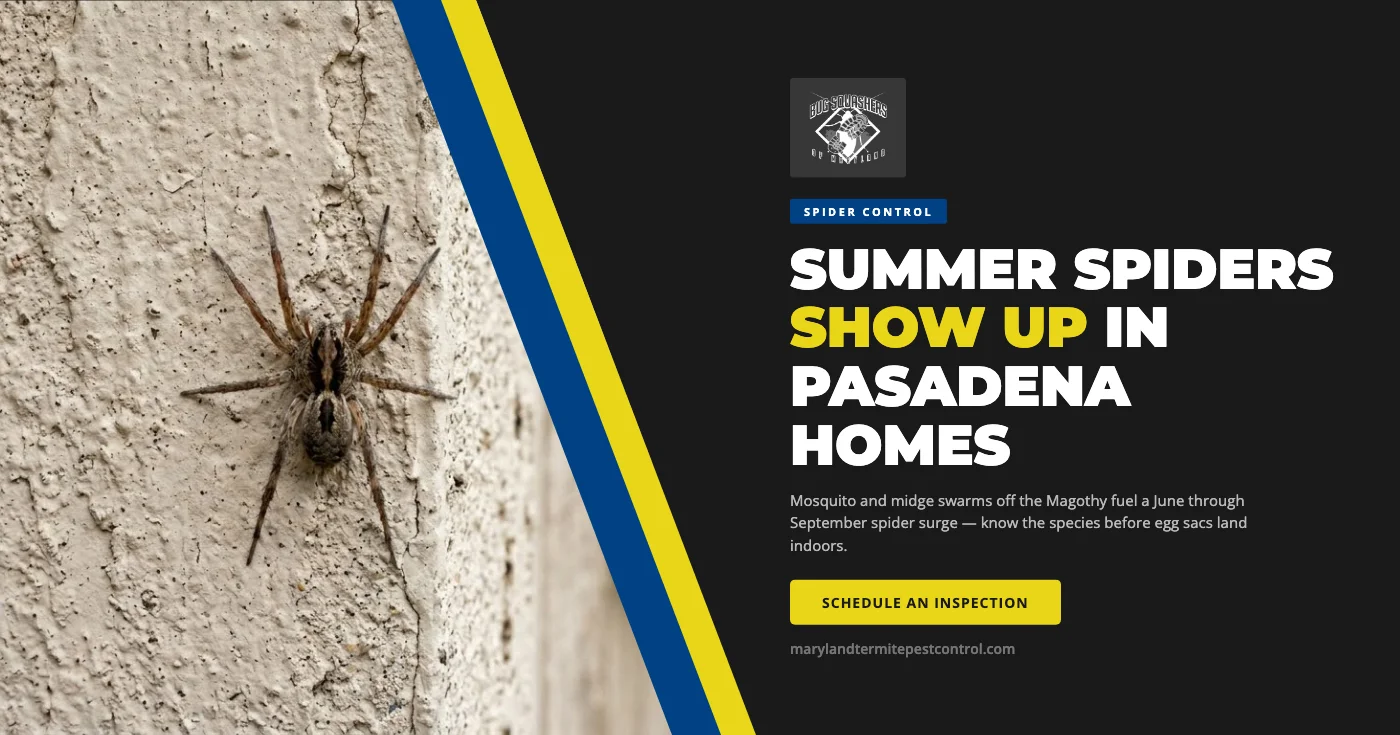
Every June, the calls start coming in. A homeowner off Mountain Road notices a fresh web stretched across the porch every morning. A family near Lake Shore opens the garage and finds a wolf spider sitting on the bumper. A waterfront resident along the Magothy is sweeping cobwebs out of the boathouse twice a week. Summer in Pasadena is when spiders move from background tenants to noticeable neighbors. At Bug Squashers, we field a steady rise in spider control requests from Anne Arundel County between June and September.
The spider control pasadena md homeowners need this season is less about extermination and more about reducing the conditions that attract spiders in the first place — abundant prey insects, undisturbed exterior clutter, and entry points that haven't been sealed since the house was built. Most spiders we encounter across Pasadena are harmless. The catch is that without a structured response, the population grows quietly through the summer until a single web in July becomes a dozen by Labor Day.
The seasonal jump is not a perception issue. Spider populations across Pasadena and the surrounding Anne Arundel County neighborhoods genuinely climb through summer, and three local conditions drive most of the increase.
None of this is a sign that a Pasadena home is dirty or neglected. It is simply the local ecology adjusting to summer, with our houses sitting right in the middle of it.
The University of Maryland Extension's overview of spiders in Maryland matches what our technicians document on Pasadena service routes. A handful of species account for the overwhelming majority of household sightings:
For most Pasadena homes, these six categories cover virtually every spider encountered in a typical summer.
Of the hundreds of spider species in the state, only one warrants real medical caution: the black widow. The Maryland Department of Natural Resources' overview of common Maryland spiders describes the female as jet black with a bright red hourglass on the underside of the abdomen, hanging upside down in her web. Black widows in Anne Arundel County stay outdoors almost exclusively, preferring sheltered spots: undisturbed garages, woodpiles, sheds, the underside of patio furniture, around well covers and meter boxes. They are not aggressive, but they will bite if pressed against skin.
The brown recluse — the other species people often worry about — does not live in Maryland. The University of Maryland Extension and the state DNR are both clear: brown recluses are not native here and cannot survive the climate. The vast majority of "brown recluse" sightings in Pasadena turn out to be a wolf spider, a yellow house spider, or a similarly colored ground spider.
The rest of the Pasadena summer roster is functionally harmless to people and pets. Most species cannot pierce human skin, and even when a bite does happen the reaction is typically no worse than a mosquito bite. The biggest practical risk is psychological — a startling encounter that triggers a fall or a swerve.
When our team walks a Pasadena home for a pasadena maryland spider extermination assessment, the inspection runs through the same predictable zones. Spiders concentrate where their food concentrates and where they are least likely to be disturbed.
Outside the home:
Inside the home:
A walk-through with this map almost always uncovers two to three times more spider activity than a homeowner initially noticed.
What kind of spiders live in pasadena md homes is partly a question of who is hunting whom. Reduce the insects, reduce the shelter, seal the entry points, and the spider population follows. Most of this is a Saturday-morning project, and the cumulative impact is significant.
Two or three of these steps applied consistently knock visible spider activity down by half or more inside a month.
DIY tactics handle most of the picture. The remaining situations are where our crew earns its place. Effective spider control pasadena md residents can rely on starts with a professional response when any of the following apply:
When our team handles a how to keep spiders out of my pasadena maryland house service call, the visit follows a five-step framework: top-to-bottom inspection of interior and exterior; identification of the species and the prey driving them; removal of visible webs and egg sacs; targeted treatment of entry points, harborage areas, and prey insects; and a follow-up cadence that keeps the property quiet through the season. Most Pasadena homes are visibly clearer after the first visit and stable after the second.
Are the spiders I'm seeing in Pasadena dangerous?
Almost certainly not. House spiders, cellar spiders, wolf spiders, jumping spiders, and orb weavers are not medically significant. Black widows live in the region but stay outdoors in sheltered spots and are easy to avoid with basic woodpile and garage habits. Brown recluses do not live in Maryland.
Why am I seeing more spiders this summer than last summer?
Local insect populations vary year to year. A wet spring around the Magothy or Patapsco watersheds fuels a heavier mosquito and midge season, which in turn supports a larger spider population.
Is it worth keeping the orb weaver in the garden?
Yes, when possible. A single black and yellow garden spider intercepts dozens of mosquitoes per night. If the web is not in a high-traffic walking path, leaving it intact has measurable benefits for the yard.
How do I tell a wolf spider from a brown recluse?
Wolf spiders are hairy, have eight eyes arranged in three rows, and patterned earth-toned coloration — often with stripes down the back. Brown recluses are not present in Maryland. If a brown spider has been spotted, it is almost certainly a wolf spider, a yellow house spider, or a ground spider, and is harmless.
Do indoor sprays from the hardware store work on spiders?
They kill the individual spider that gets sprayed and little else. Spiders pick up less residue than insects because they walk on the tips of their legs. Long-term spider control pasadena md homes need depends on entry-point sealing and reducing the prey base, not contact sprays.
What's the best time of year to call for spider control?
Early summer is the most effective window for Pasadena homes. Catching the population before the second egg-sac cycle in July prevents the late-summer surge. Contact Bug Squashers to schedule an inspection of your Pasadena home.