
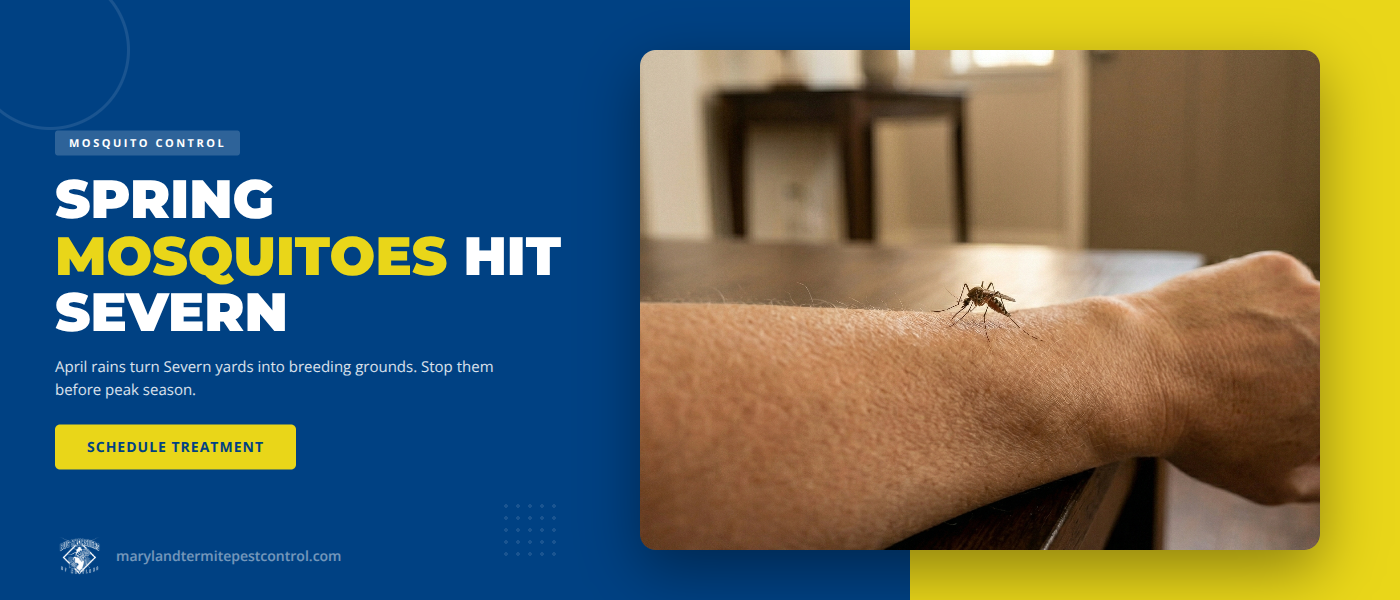
By the time April rains stop falling in Anne Arundel County, the mosquitoes are already winning. Eggs that overwintered in flowerpots, clogged gutters, and forgotten buckets are hatching, and a new generation of biting females is just days from taking flight. At Bug Squashers, we see calls climb the same week the showers ease — homeowners stepping into their backyards and getting bitten before they reach the grill. That's why mosquito control severn md residents schedule each spring is less about reacting to bites and more about getting ahead of a population that doubles fast in our humid Mid-Atlantic climate.
Spring is the make-or-break window. Treat early and you knock back the breeding cycle before peak season. Wait until July, and you're chasing a swarm that's already two or three generations deep. In this guide, we break down why Severn yards turn into mosquito factories after April rains, where the worst breeding sites hide, and what effective mosquito control severn md homeowners need looks like in practice.
Mosquito season in Maryland used to start in May. That's no longer the case. Warmer, wetter springs across the Chesapeake region have pushed first activity into early April, and the Maryland Department of Agriculture's Mosquito Control Program now runs surveillance traps from spring through October across our region. For Severn — sitting between the Patapsco and Severn Rivers in central Anne Arundel County — that means an extended biting season every year.
Three things drive the spring ramp-up our team sees in Severn:
The species we deal with most often in Severn yards are the Asian tiger mosquito (Aedes albopictus) and the northern house mosquito (Culex pipiens). Tiger mosquitoes are aggressive daytime biters that lay eggs in tiny pools of water — even a bottle cap is enough. Culex species prefer larger, stagnant water and are the primary West Nile virus carriers in our area. Both thrive in suburban Severn neighborhoods.
Every mosquito problem starts with water. Female mosquitoes need a still, untouched surface to lay their eggs, and from egg to biting adult takes as little as 7 to 10 days in warm weather. That means a single rainstorm in mid-April can produce a fresh wave of biters by the first weekend of May.
What surprises most Severn homeowners is how little water mosquitoes need. We've found active larvae in:
According to the University of Maryland Extension, eliminating standing water on a property is the single most effective step a homeowner can take to reduce mosquito populations — more impactful than any over-the-counter repellent or yard spray applied without a source-reduction plan. That's why our first visit always starts with a property walkthrough, not a sprayer.
Severn's mix of older split-levels, newer townhomes, and wooded lots backing up to wetlands creates a wide range of breeding conditions. When we inspect a property, we focus on the spots most homeowners overlook:
Homes near the Severn River, Sawmill Creek, and the Patapsco floodplain see noticeably heavier pressure than properties farther from water. We tailor treatment intensity to each property's exposure.
Mosquitoes in Maryland aren't just a nuisance — they're a public health concern. The Anne Arundel County Health Department tracks several mosquito-borne diseases throughout the season, and Severn sits inside the Baltimore-Washington corridor where surveillance is most active.
The most relevant risks for our area include:
The more bites your household takes, the higher the cumulative odds of exposure. Reducing the mosquito population around your home is the most effective way to lower that risk — a key reason mosquito control severn md families count on isn't optional for households with kids, older adults, or outdoor pets.
Before peak season hits, there are simple, immediate actions that meaningfully cut down breeding pressure on a property. We recommend Severn homeowners walk their yard with the following checklist:
These steps make a noticeable dent — but in a Severn neighborhood with mosquitoes drifting in from a neighbor's yard, a stormwater pond, or a wooded buffer, source reduction alone isn't always enough.
Most Severn homeowners try the box-store sprays first. Some help temporarily; many don't. Here are the signs we hear from new clients that tell us it's time to bring in a professional:
Professional mosquito control severn md homeowners depend on doesn't replace source reduction — it works alongside it. Our team reaches what the homeowner can't: dense shrub interiors, tree canopies up to 15 feet, drainage features, and shaded resting habitat where adult mosquitoes hide between meals.
Our approach to mosquito control is built around one principle: kill the breeders, knock down the biters, and keep them from coming back. Every mosquito control severn md property we service gets the same five-step process:
We service residential properties throughout Severn and across Anne Arundel County, including Hanover, Glen Burnie, Severna Park, Pasadena, Odenton, and Crofton. Whether you're prepping for backyard season, planning a summer wedding, or just tired of getting bitten in your own yard, we'll build a treatment plan around your property's exposure.
Mosquito activity in Severn typically begins in early to mid-April once soil temperatures hold above 50°F and spring rains refill standing water. Peak biting pressure runs from late May through September, and activity often continues into October. We recommend starting treatment in April so the first generation never establishes.
From egg to biting adult takes as little as 7 to 10 days in warm Maryland weather. A single April storm that fills a clogged gutter or forgotten bucket can produce a new wave of mosquitoes by the following weekend. That's why source reduction within 48 hours of rainfall matters so much.
Yes — though results are best when neighboring properties also reduce their breeding sites. Our barrier treatments knock down mosquitoes that drift into your yard and target the resting habitat where they hide. We routinely see 70 to 90 percent reductions in biting pressure on treated properties even when adjacent yards are untreated.
For most Severn properties, a treatment every three to four weeks from April through October provides reliable suppression. Properties near wetlands, drainage ponds, or wooded buffers may benefit from more frequent service during peak months. We adjust the schedule based on what we see during each visit.
The products we use are EPA-registered for residential mosquito programs and applied at label-rate to vegetation rather than surfaces where kids and pets play. We ask households to stay off treated foliage until it dries — usually 30 minutes to an hour. Once dry, the area is fine for normal use.
Spring is the cheapest, most effective time to address mosquitoes. Treat now and you suppress the founding generation before it produces the swarm that ruins July and August. Wait, and you're spending the rest of the season catching up. The mosquito control severn md families rely on works best when it starts in April — not when the first cookout gets called off because the deck is unusable.
If you're seeing the first bites of the year or want to lock in coverage before peak season, we're here. Contact Bug Squashers for a property inspection and a treatment plan built around your yard. We've protected Severn homes through many mosquito seasons.