
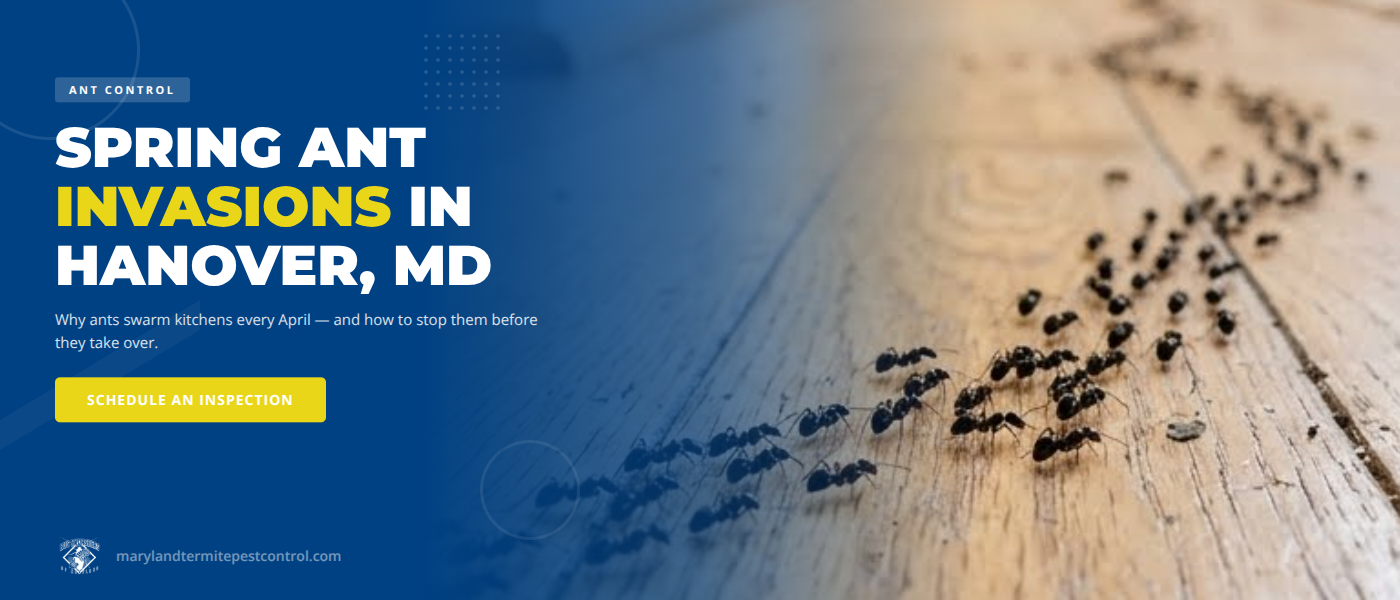
Every April, homeowners across Hanover, MD face the same unwelcome surprise: columns of tiny ants streaming across kitchen countertops, clustering around the sink, and forming trails along baseboards that seem to appear out of nowhere. This spring ant invasion is one of the most common pest complaints we receive at Bug Squashers of Maryland, and it is driven by a combination of warming temperatures, increased rainfall, and the biology of the ant species that thrive in the Mid-Atlantic region. Understanding why ants swarm Maryland kitchens in April gives you the knowledge to protect your home before they take hold.
April marks a critical turning point in the annual pest cycle for Hanover and the greater Anne Arundel County area. After months of winter dormancy, ant colonies respond to rising temperatures by dramatically increasing their foraging activity. When daytime temperatures consistently reach above 50 degrees Fahrenheit, worker ants begin sending out scouts in search of food and water sources. In Maryland, this threshold is typically crossed in late March to early April, setting the stage for the spring invasion.
Rainfall plays an equally important role. April showers are a hallmark of Maryland spring weather, and sustained periods of rain can trigger indoor ant invasions within two to four days. When the soil around your home's foundation becomes saturated, underground ant colonies are displaced, pushing workers upward and toward the nearest dry shelter, which is often your home. The combination of warmth and moisture creates a perfect storm that drives thousands of foraging ants through every available crack and crevice in your foundation, siding, and door frames.
We also see reproductive swarmers emerging from mature colonies during April and May. These winged ants leave their parent colony to mate and establish new nests, and they are frequently spotted near windows, light fixtures, and exterior doors. The presence of swarmers inside your home is a strong indicator that a colony has already established itself within or very near the structure.
Not all ants behave the same way, and knowing which species you are dealing with is essential for effective treatment. In the Hanover area, four ant species are responsible for the overwhelming majority of spring kitchen invasions.
Odorous house ants are the most frequent kitchen invaders we encounter in Hanover, MD. These small, dark brown to black ants are easily identified by the foul, rotten-coconut-like odor they release when crushed. They form large colonies with multiple queens and are strongly attracted to sweet foods, sugary spills, and moisture around sinks and dishwashers.
Odorous house ants typically begin foraging in early to mid-March in the Mid-Atlantic region, with trail activity intensifying through April. In mild winters, we have seen foraging trails appear as early as late February. These ants establish extensive pheromone trails between their nests and food sources, which is why you often see them moving in well-defined lines along countertop edges, baseboards, and cabinet frames.
One of the biggest challenges with odorous house ants is that improper treatment can make the problem worse. When a colony is disturbed by surface sprays, it frequently splits into multiple satellite colonies, a process called budding. This can spread the infestation from one area of your home to several, making professional treatment essential.
Pavement ants are another common spring invader in Hanover. These small, brown to black ants get their name from their habit of nesting in cracks in sidewalks, driveways, and foundation slabs. They push up small mounds of soil along pavement joints and concrete edges, which is often the first visible sign of their presence.
During spring rains, pavement ants are driven out of their ground-level nests and frequently enter homes through expansion joints in garage floors, cracks in basement slabs, and gaps around ground-level utility penetrations. They are attracted to greasy and protein-rich foods as well as sweets, making kitchens with cooking residue particularly appealing.
Carpenter ants are the largest ants in Maryland, with workers measuring up to half an inch long. They pose a structural threat because they excavate galleries in wood to build nests, particularly wood softened by moisture. This is common in Maryland homes where rain and humidity create persistent damp conditions in wall voids, window frames, and crawl spaces.
Spring is the primary swarming season for carpenter ants in the Hanover area. Large winged ants emerging from walls or around windows between April and June are a warning sign that a mature colony is nesting inside your home. Piles of fine, sawdust-like frass near baseboards or structural timbers indicate active excavation and require professional intervention.
Pharaoh ants are tiny, light yellow to reddish-brown ants that are particularly problematic in kitchens and bathrooms. They are attracted to sweets, fats, and proteins, and they nest in warm, humid areas such as wall voids near hot water pipes, behind baseboards, and inside electrical outlet boxes. Pharaoh ants form massive colonies with hundreds of queens and readily bud into new satellite colonies when disturbed, making professional baiting programs the only reliable approach.
Kitchens are the most common location for ant infestations in Hanover homes, and for good reason. Every ant colony needs three things to survive: food, water, and shelter. Your kitchen provides all three in abundance.
Once scout ants locate a food or water source in your kitchen, they lay down a pheromone trail that guides hundreds or thousands of additional workers to the same location. This is why a few ants on Monday can become a steady stream by Wednesday. The trail acts as a chemical highway that persists even after you wipe down the surface, unless it is thoroughly cleaned with a solution that breaks down the pheromone compounds.
Taking proactive steps before ant season hits full force can significantly reduce the likelihood of an infestation in your home. Here is what we recommend for Hanover homeowners:
We understand the temptation to grab a can of ant spray or set out store-bought bait traps at the first sign of ants. Unfortunately, these DIY approaches almost always fall short for several reasons.
Surface sprays kill only the foragers you can see, which represent a small fraction of the colony. The queen and bulk of the colony remain untouched. With odorous house ants and pharaoh ants, spraying can trigger colony budding, where the colony splits into multiple new colonies in different locations. What started as one ant trail can quickly become several.
Store-bought baits are often formulated with attractants that do not match the dietary preferences of the specific species invading your home. Ant food preferences change seasonally, and a bait that does not match their current preference will be ignored entirely.
At Bug Squashers of Maryland, we identify the ant species, locate the colonies, and deploy professional-grade baits designed to be carried back to the nest by foraging workers. This eliminates the entire colony, including queens and brood, rather than just visible ants. Our treatments are family-friendly and pet-friendly, and we back our results with follow-up inspections.
April brings the combination of warming temperatures and increased rainfall that activates dormant ant colonies and drives foraging activity into high gear. When soil becomes saturated from spring rain, underground colonies are displaced and workers seek food and shelter inside your home. Kitchens are the top target because they provide the food and moisture sources that ants need to sustain their colony.
The small black ants most commonly found on kitchen counters in Hanover are odorous house ants. You can confirm this by gently crushing one and checking for a distinctive rotten-coconut smell. Pavement ants are another possibility, especially if you notice small soil mounds along cracks in your driveway or sidewalk near the house. Proper identification is important because each species requires a different treatment strategy.
Spraying visible ants with over-the-counter bug spray is generally ineffective and can make the problem worse. Surface sprays only kill the foragers, leaving the colony intact. With species like odorous house ants and pharaoh ants, spraying can cause the colony to split into multiple satellite nests, spreading the infestation to other areas of your home. Professional baiting programs that target the entire colony are much more effective and reliable.
Carpenter ants are significantly larger than most household ant species, typically measuring a quarter inch to half an inch long. They are usually black, though some species may have reddish-brown coloring. Look for piles of fine, sawdust-like wood shavings near baseboards, window frames, or structural timbers. Carpenter ants also produce a faint rustling sound inside walls when colonies are large. If you suspect carpenter ants, professional inspection is strongly recommended because of the structural damage they can cause.
We recommend calling a professional if you see persistent ant trails that return after cleaning, find winged swarmers inside your home, notice sawdust-like debris near walls or woodwork, or if store-bought treatments have failed to resolve the issue. Early intervention is the most cost-effective approach because it stops the colony before it has time to expand, split, or cause structural damage.
April ant invasions are predictable, and that means they are preventable. Our team at Bug Squashers of Maryland has the experience, the tools, and the expertise to identify the ant species in your home, locate their nesting sites, and eliminate the entire colony. We do not just treat the symptoms. We find the source and address the conditions that attracted ants in the first place.
Contact us today to schedule your spring ant inspection and take back your kitchen before the invasion gets out of hand.