
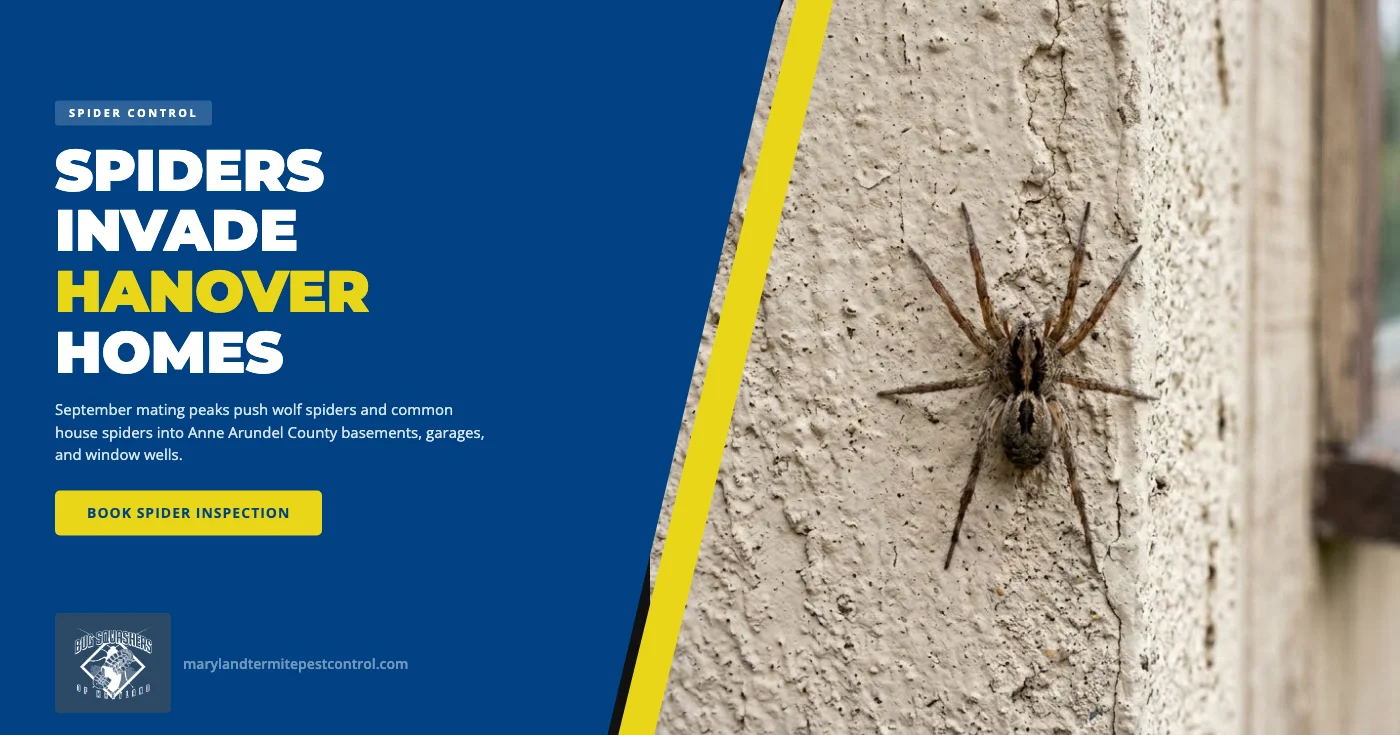
The first mid-September evenings in Hanover, MD bring a scatter of new spider sightings — a wolf spider in the basement, a wispy web in the garage corner, a jumping spider on the window frame at dusk. At Bug Squashers, we see the calls climb the moment overnight lows drop out of the 60s, and the reason isn't just temperature. September in Anne Arundel County marks the peak of native spider mating season, when adult males leave their outdoor territories and roam farther than any other time of year — often ending that search inside a Hanover home. The spider control hanover md families need this month is preventative: seal the gaps, dim exterior lighting that draws prey insects, and know which species actually warrant concern. Our spider control crew has worked these ZIPs for years, and we'll walk you through what's happening this month.
The pop-culture story — that spiders flee cold weather and swarm indoors — is mostly wrong. The University of Maryland Extension and Maryland DNR agree on the actual mechanism, and it comes down to three overlapping biological cues that peak in Hanover during the second and third weeks of September.
First, September is mating season for most of the common spider species Anne Arundel County families notice inside their homes. Males that spent all summer maturing in leaf litter, foundation vegetation, and garden edges reach sexual maturity in late August and early September. Once mature, they leave their territory and roam — often for weeks — looking for a female. That single behavioral shift is the largest driver of the fall spider infestation hanover homeowners see each year. It isn't a cold-weather migration. It's a courtship search that happens to cross open doorways and garage gaps.
Second, prey insects concentrate near the house perimeter in September. Cooler evenings drive moths, flies, gnats, and midges toward exterior lighting, warm siding, and CO₂ plumes escaping through soffits and dryer vents. Where prey goes, spiders follow.
Third, surviving females and older juveniles begin looking for sheltered egg-laying and overwintering sites. Cellar spiders, common house spiders, and yellow sac spiders spend the entire cold season inside if they find the right cavity. UMD Extension notes wolf spiders in particular "come indoors most frequently in the fall and are usually found in basements" — the biology backs up what our crews document on every September call across Hanover.
Five species drive roughly ninety percent of the house spider removal maryland calls our team runs each fall. Correct identification changes what a homeowner should do — the response to a cellar spider in a basement corner differs from a wolf spider in a bedroom.
When our crew runs a spider exterminator anne arundel county inspection, we work through the same interior map every visit. Spider harborage is remarkably consistent across the split-levels, ranchers, and townhomes that dominate Hanover housing stock:
For every spider a Hanover homeowner spots on the wall, seven to ten more are living quietly in the spaces above.
Almost every spider inside a Hanover home this September is medically harmless. Only one native species warrants concern, and one non-native species gets blamed for problems it isn't causing.
The northern and southern black widow — the only medically significant native spider in Maryland. Maryland's Department of Natural Resources confirms the black widow is "the only native Maryland spider that is dangerous to people." Adults are jet-black with a red or orange hourglass on the underside of the abdomen. Black widows prefer undisturbed low-light spaces: window wells, under porches, storage sheds, woodpiles, and stored boxes in Hanover garages. Bites happen when a hand reaches into an area the spider is defending. A confirmed black widow bite warrants urgent-care evaluation, especially for children or older adults.
The brown recluse — the spider that isn't here. Both UMD Extension and Maryland DNR are explicit: brown recluse spiders are not native to Maryland and cannot survive the local winters. Rare stowaways occasionally arrive in packages, but there is no established breeding population in Anne Arundel County. Maryland DNR notes that many suspected "brown recluse bites" in the Mid-Atlantic are actually MRSA infections or bites from the yellow sac spider — a much more common local species that produces similar-looking lesions.
When our team gets called for spider identification at a Hanover home, we usually rule out both species within minutes. The far more common culprit is a homeowner who spotted a wolf spider, jumping spider, or house spider and wanted a professional read. Ninety-nine percent of the time, the answer is: harmless.
Homeowners who reach out mid-infestation have almost always tried something first — aerosol sprays, over-the-counter perimeter treatments, ultrasonic plug-ins, essential oils. Most produce a brief cosmetic drop in visible spiders and no real reduction in pressure. Here's what our crew sees fail most often on the spider pest control glen burnie md and Hanover calls we run:
Our spider control hanover md program addresses each of these failure modes with structured steps rather than a one-size aerosol — fewer visible spiders now, fewer overwintering females later, and a lower baseline going into next spring.
The single highest-value September weekend for Hanover homeowners is a full spider-proofing walk-through. Most of the work is straightforward and doesn't require product:
For families across Hanover, Odenton, Severn, Glen Burnie, Crofton, and the rest of Anne Arundel County, our spider control hanover md program pairs a full interior and exterior inspection with crack-and-crevice treatment, exterior perimeter application timed to the September mating peak, physical removal of visible spiders and egg sacs, and a written prevention plan tuned to that specific home. We return on scheduled follow-ups until the property is clear.
Are the spiders I'm seeing in September dangerous?
Almost never. Most spiders inside a Hanover home this month are wolf, cellar, jumping, or common house spiders — all medically harmless. The only native Maryland spider warranting concern is the black widow, which prefers undisturbed low-light spaces like sheds and window wells.
Are brown recluse spiders in Anne Arundel County?
No established population. Maryland DNR and UMD Extension both confirm brown recluse spiders are not native to Maryland and cannot survive the local winters. Most suspected "brown recluse bites" in the Mid-Atlantic are misidentified skin infections or yellow sac spider bites.
Why am I seeing so many spiders indoors right now if it isn't cold yet?
It's mating season, not cold-avoidance. Male spiders reach maturity in late August and September and roam looking for females — that single shift produces most of the increased sightings.
Do essential oils, ultrasonic devices, or peppermint spray really keep spiders out?
Not meaningfully. No independent research shows ultrasonic devices reduce spider populations. Physical exclusion — caulking gaps and installing door sweeps — is what actually works.
What's the best way to remove an egg sac I found in my garage?
Vacuum it up and dispose of the bag outside immediately. A single common house spider egg sac can hold one hundred to four hundred spiderlings.
When should I schedule spider control in Hanover, MD?
Late August through early October is the highest-value window — it catches males during peak mating dispersal, removes egg sacs before hatching, and closes exterior gaps before overwintering species settle in. Contact Bug Squashers to schedule your spider control hanover md inspection before the fall spider infestation hanover families see every year settles into your home.