
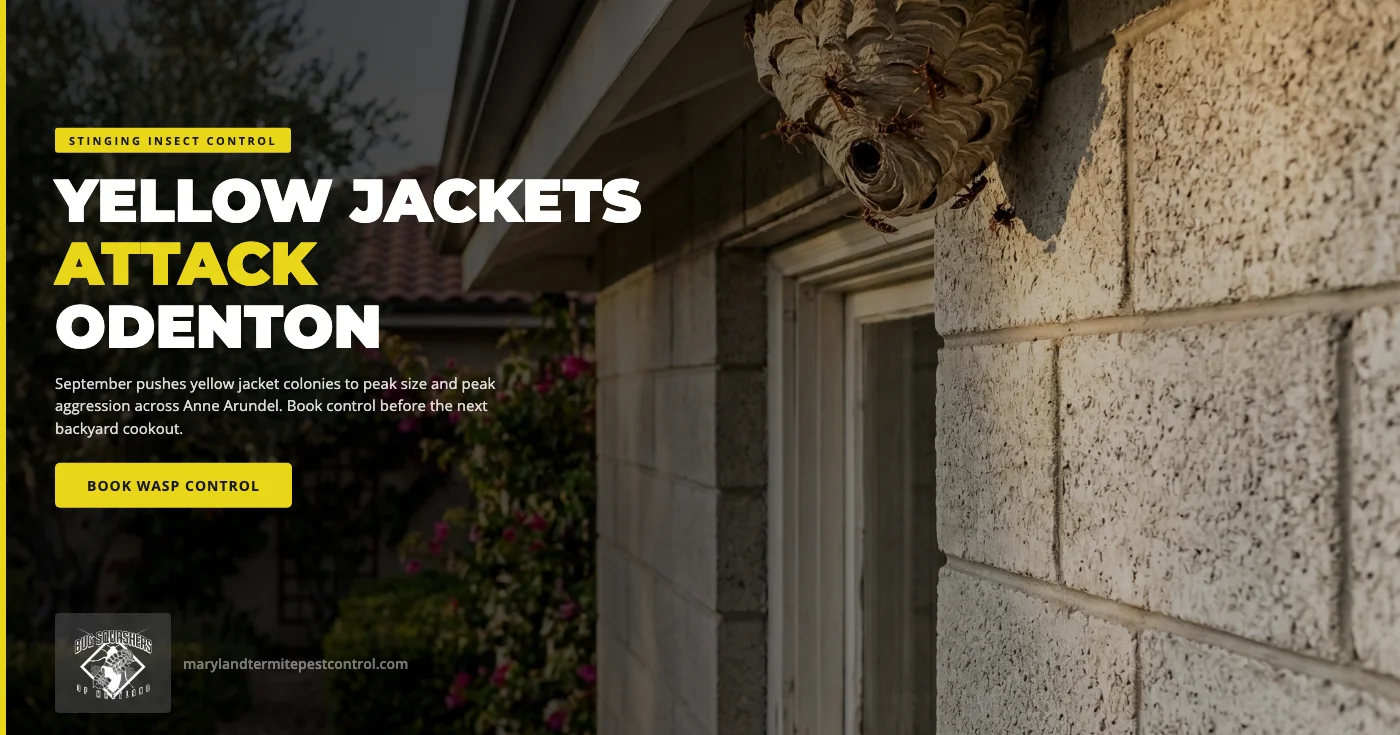
By mid-September in Odenton, MD, the yellow jacket calls to Bug Squashers spike hard — a nest that seemed quiet in July suddenly aggressive at the compost bin, workers dive-bombing the trash can, a hidden ground colony that a homeowner ran a mower over on Saturday afternoon. September marks the annual peak for eastern and German yellowjacket colonies across Anne Arundel County, when populations that started with a single overwintering queen in April have grown to two or three thousand workers. The yellow jacket control odenton md families need this fall is not a paper-wasp problem — the biology, the risk profile, and the removal approach are all different. Our stinging insect control team has worked the Odenton, Crofton, and Gambrills ZIPs through multiple fall seasons, and here's what's happening in your yard right now.
Two overlapping biological shifts drive the September danger, both documented by the University of Maryland Extension and Cornell University's Integrated Pest Management Program.
First, colony size peaks. A nest that housed a few hundred workers in June holds two to three thousand by the second week of September in the Baltimore-Washington corridor. Every one of those workers is a defender. That raw multiplier is why a September nest hit with a lawn mower produces a mass sting event, while the same nest in June rarely does.
Second, the queen stops laying worker eggs. Worker yellowjackets get most of their nutrition from a sugary secretion the larvae produce as workers feed them protein. When the larvae disappear in late August, so does that internal sugar supply. Thousands of mature workers — no longer needed to hunt for the nest — start foraging for external sugar: fallen apples, hummingbird feeders, soda cans, open trash. That is the origin of the "aggressive yellow jackets at the barbecue" experience Odenton families run into every Labor Day weekend.
Combined, a September colony is bigger, hungrier, and vastly more defensive than the same colony was in June. UMD Extension notes yellowjackets "have a reputation for being easily agitated" and that "vibrations from lawn mowers or hedge clippers can trigger defensive responses" — which is why wasp control maryland fall calls to our office spike from Labor Day forward.
Yellow jackets are frequently mistaken for paper wasps, honey bees, or European hornets — and the response to each is different. Correct identification is where every wasp nest removal odenton maryland call our team runs actually begins.
The wasp itself. Yellow jackets are about half an inch long, with sharp black-and-yellow banding and a smooth (not fuzzy) body. Honey bees are hairier and less sharply patterned. Paper wasps are longer and thinner with dangling legs in flight. European hornets are much larger and brownish.
Where they nest. Yellow jackets in Maryland use three primary nest locations, and each drives a different removal approach:
The traffic pattern. The most reliable test is watching workers go in and out of one specific point. Yellow jackets fly a straight line to and from the entrance — no zigzag, no hover. Ten or more per minute means a mature colony.
Every September, our phones ring with Odenton homeowners who tried to handle a nest themselves and ended up with stings, a partial-removal failure, or both. There is a reason yellow jacket removal is the one fall pest situation our crew consistently advises against as a homeowner project.
Mass sting events. Unlike honey bees, individual yellow jackets can sting repeatedly. UMD Extension confirms that "attacking workers release alarm pheromones that summon nestmates" — a chemical alarm signal that pulls dozens or hundreds of additional wasps out of the nest in seconds. Twenty to fifty stings in under thirty seconds is a documented outcome. Yellowjackets are responsible for the majority of insect-sting fatalities in the United States each year, largely because ground-nesting behavior leads to accidental disturbances by homeowners doing routine yard work.
Store-bought sprays underdeliver. The aerosol wasp-and-hornet cans on hardware-store shelves are designed for exposed paper-wasp nests. They are marginally effective against an underground yellow jacket colony where the queen and most of the workers are twelve to twenty-four inches below the entrance hole. A homeowner who empties a can into the hole at dusk usually kills the workers near the entrance, drives the rest deeper, and returns the next morning to find the colony fully active and now defensive.
Wall-void nests turn into interior emergencies. Sealing a nest entrance on a German yellowjacket colony in a wall void is one of the worst DIY responses our team has to unwind. The colony redirects, chews through drywall or an interior air gap, and emerges inside a bedroom or bathroom.
Waiting for frost isn't a plan. The colony dies at first hard frost, which in Anne Arundel County usually falls between mid-October and early November. The four to six weeks before frost are when the colony is largest, hungriest, and most defensive.
A healthy adult can tolerate a moderate number of yellow jacket stings with local pain and swelling. That isn't the medical concern we're managing in September. The concern is the small percentage of Odenton families — children, older adults, and undiagnosed insect-venom allergics of any age — for whom a single sting can trigger anaphylaxis.
Anaphylaxis onset is measured in minutes. A systemic allergic reaction to yellow jacket venom involves airway constriction, dropping blood pressure, hives beyond the sting site, and cardiovascular shock, typically within five to thirty minutes. Approximately forty to fifty insect-sting fatalities occur in the United States each year, with yellow jackets responsible for the majority. Many victims did not know they were allergic before the fatal sting.
Children face compounded risk. Smaller body mass means higher venom concentration per pound. A child who steps on a ground nest and receives twenty stings faces a very different medical picture than an adult with the same count.
What to do after a sting. A single sting in a non-allergic person is a soap-and-water, cold-compress, over-the-counter-antihistamine situation. Any sign of hives away from the sting site, throat tightness, difficulty breathing, dizziness, or swelling of the face or lips is a 911 call. Odenton families with a known venom allergy should carry a current epinephrine auto-injector from Labor Day through the first hard frost, and any child stung more than five to ten times warrants a same-day pediatric evaluation regardless of allergy status.
A professional yellow jacket exterminator anne arundel county call runs differently from a general pest visit. The colony's defensive response is the whole design constraint, and our September protocol reflects that.
Inspection first, treatment second. Our technician's first task is confirming the species, locating the actual nest (the entry hole can be twelve to eighteen inches offset from the underground chamber), and mapping the flight path. We use the observed entry rate to size the response.
Timing the treatment. Yellow jackets return at dusk, and worker traffic drops sharply after sunset. We time treatment for that low-traffic window when possible. For active daytime emergencies — a nest in a garage with kids using the space, or a wall void producing interior wasps — we treat during the day with full protective equipment.
Targeted product placement. Underground and wall-void nests are treated with professional-grade dust products applied directly to the entrance. Workers carry the material into the chamber on their bodies, and the colony receives full exposure within twenty-four to forty-eight hours — including the queen and the developing next-year queens. This is fundamentally different from aerosol saturation, which only reaches wasps within a foot of the treated opening.
Physical removal and follow-up. Once the colony is confirmed inactive — usually forty-eight to seventy-two hours post-treatment — we return to physically remove aerial nests, seal wall-void entry points, and treat the surrounding perimeter to discourage re-nesting. Fall stinging insect control odenton work carries monitoring through the first hard frost, and if a homeowner sees new activity inside two weeks, we return at no additional cost.
The best fall for yellow jacket management is the previous spring. Every prevention layer added reduces the odds of a peak-season colony in your yard next September.
When do yellow jackets die off in Anne Arundel County?
The colony dies at the first hard frost, which in Odenton typically arrives between mid-October and early November. Newly mated queens overwinter separately and start new colonies the following spring. The old nest is not reused.
Can I just wait until the frost kills the nest?
Technically yes, but the four to six weeks before frost are when the colony is largest and most defensive. If the nest is near a walkway, deck, garage door, or kids' play area, waiting is the highest-risk option available.
What's the difference between yellow jackets and paper wasps in Maryland?
Paper wasps are longer, thinner, and less aggressive. They build small open-cell umbrella nests visible under eaves and rarely reach more than a hundred workers. Yellow jackets are shorter, more banded, more defensive, and build colonies of two to three thousand hidden underground or in wall voids.
Is my dog or cat at risk from a yard nest?
Yes. Dogs and cats investigating a ground nest can trigger the same alarm response as a human, and their smaller size means severe reactions from a moderate sting count. Immediate veterinary evaluation is the response.
How fast can Bug Squashers respond to an active nest?
For active nests in high-traffic areas, our team schedules same-week or next-day inspections through the fall stinging insect season. Contact Bug Squashers to book your Odenton yellow jacket inspection before the colony hits its full three-thousand-worker size.