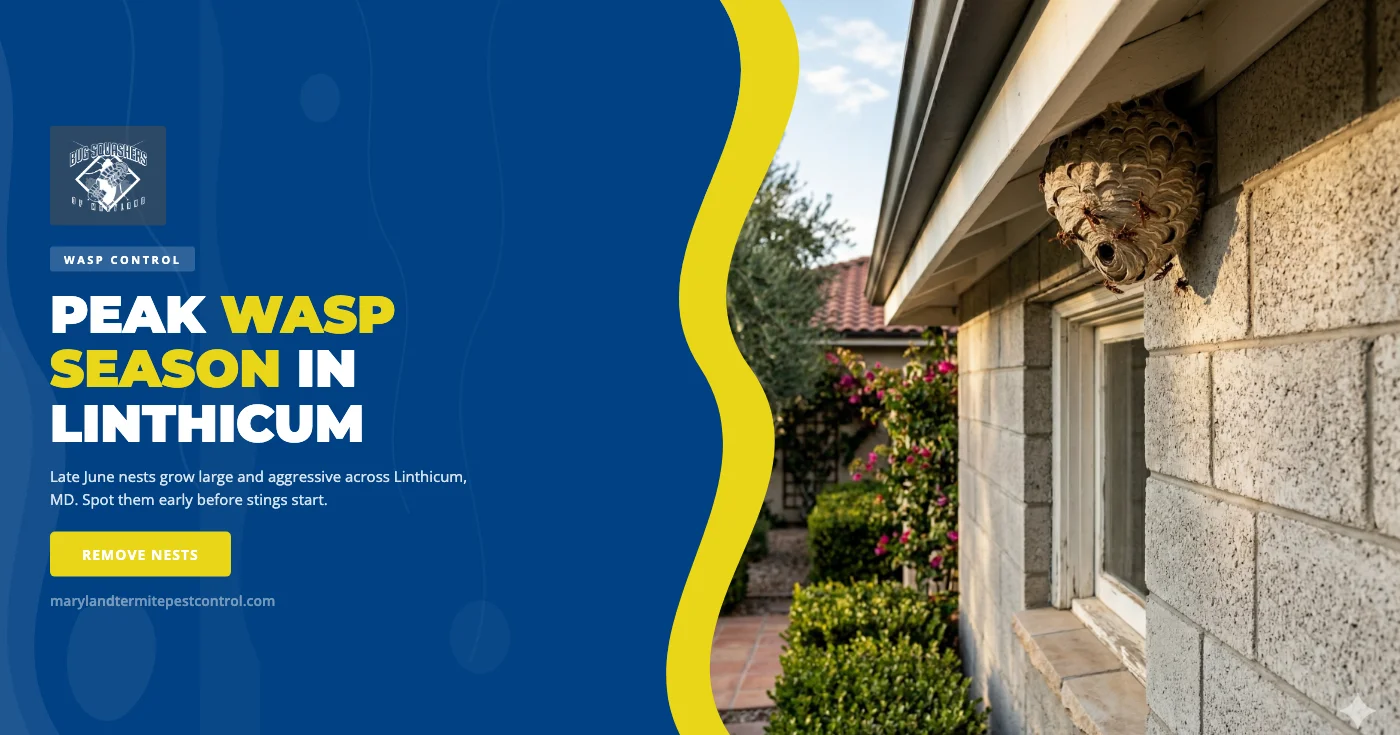
By late June, our phones in Anne Arundel County start ringing with the same kind of call: a Linthicum homeowner who walked past the same eave or shrub for six weeks and suddenly noticed wasp traffic where there used to be none. Paper wasp, yellowjacket, and bald-faced hornet colonies that started as a single queen in April have spent the spring quietly producing workers. Right around the summer solstice, those colonies cross the threshold from "starter nest" to "active, defended perimeter." That is why Bug Squashers sees a spike in wasp control linthicum md service requests every late June — by the time most homeowners notice the nest, the workers are already defending it.
Wasp populations do not climb in a straight line through the summer. According to the University of Maryland Extension, social wasp colonies start in spring with a single overwintered queen who builds a small starter nest and raises the first batch of workers alone. Once those workers emerge — usually in May for our part of Maryland — they take over construction and foraging, and the queen shifts to laying eggs full time. From that point on, the colony grows exponentially.
Linthicum sits on Maryland's Coastal Plain, where Chesapeake-influenced humidity and the urban heat from the BWI corridor push the schedule one to two weeks ahead of inland Maryland. By the last week of June, paper wasp nests in our service area typically have 30 to 60 active workers, and yellowjacket colonies are pushing into the low hundreds. The absolute peak does not arrive until late August or September (yellowjackets can reach 1,000 to 5,000 workers in a single nest), but late June is when the population becomes impossible to ignore.
A nest you could have knocked down with a broom in late April now has a defensive worker force surrounding it. Wait two more months and you are dealing with a colony ten times the size.
Three groups of social wasps account for almost every nest we treat in Linthicum and across Anne Arundel County. Each one builds differently and responds differently to disturbance.
Paper wasps. The most common wasp on homes in Anne Arundel County. The University of Maryland Extension lists them at ⅝ to nearly 1 inch long, colored yellow-and-black or brick-red brown. Their legs dangle visibly in flight, which is the easiest way to tell them apart from yellowjackets at ten feet. They build the recognizable open umbrella nest — a single layer of hexagonal cells with no paper envelope. You see them under eaves, behind shutters, inside porch lights, and tucked into a child's playset.
Yellowjackets. Smaller (⅜ to ⅝ inch), smooth, bright yellow-and-black, with a compact flight pattern. They cause most serious sting incidents around Linthicum. They build enclosed paper nests inside cavities: old rodent burrows in the lawn, wall voids, soffit boxes, behind brick veneer, hollow landscape timbers, and dense shrubs. By late summer, a single underground yellowjacket nest can hold thousands of workers, all of which mobilize if the entry hole is disturbed.
Bald-faced hornets. Actually a large yellowjacket species — black and white with a distinctive white face. They build football-shaped gray paper nests that hang from tree limbs, building overhangs, and occasionally a deck arbor. UMD Extension notes those nests can hang as high as 60 feet, though we typically find the problem ones at eight to twenty feet — too high for homeowners to reach, low enough to be a hazard on a deck or near a pool.
The two-story colonials around Twin Oaks and the brick ramblers north of MD-170 each have their own wasp problem spots. When we walk a Linthicum property for a wasp call, here is where we check first:
By late June the warning signs are subtle until they are not. Here is what we tell Linthicum homeowners to watch for:
Catching the nest in late June — before it doubles or triples in size — makes treatment quicker and lower risk to everyone on the property.
We understand the impulse. A can of foaming spray costs eight dollars, the nest is right there, and the bedroom window is twenty feet away. Every wasp season we get calls after a DIY attempt has gone wrong — and almost every time, the underlying issue is one of these:
Wasps can sting repeatedly. Unlike honeybees, wasps do not lose their stinger. A single yellowjacket can sting a person dozens of times in seconds, and the colony responds to attack by mobilizing every worker. A nest that looked like ten wasps from the patio can produce a hundred defenders in under a minute.
The medical risk is not theoretical. Stinging insect venom is one of the most common triggers of severe allergic reactions in adults. The Asthma and Allergy Foundation of America notes that systemic reactions to wasp and yellowjacket stings can progress to anaphylaxis within minutes — sometimes ten minutes or less — and that epinephrine is the only effective rescue treatment. Most people who turn out to be allergic do not know it until their first reaction.
Late June nests are too populated for surface treatment. A pyrethroid spray works on a five-cell paper wasp nest in April. By late June, the nest behind that same shutter has fifty workers, and you cannot reach them all from outside. Survivors disperse, rebuild within feet of the original spot, and the next attempt is angrier than the first.
Ladders and stings do not mix. The most common serious injury we see from DIY wasp work is not the sting — it is the fall off the ladder when the sting happens.
Hidden nests cannot be treated from outside. Wall-void and ground nests need an applicator that reaches into the cavity, treats the colony at the entry point, and leaves a residual for the foragers returning later. Surface spray drives those returning workers into the next available cavity — often deeper into the structure.
Protecting your family's well-being is worth more than the price of a service call.
Our wasp service visits follow a clear sequence: identify the species, locate every active nest, treat the colony at the entry point with the right product, and set up a perimeter that discourages new queens from rebuilding in the same spots.
A typical first visit takes about 45 minutes. We start with a walk of the property — eaves, soffits, shutters, deck framing, mailbox, shed, grill, playset, and shaded shrub beds — and we listen at suspect wall voids. Once we confirm the nest, we treat with a labeled product applied at the entry point so returning foragers carry it back into the colony. For above-ground nests we can reach, we remove the nest material on a follow-up visit once the colony is no longer active. For wall and soffit nests, we treat the cavity and physically close the entry point so the void cannot be reused.
Most Linthicum properties on our seasonal plan get a perimeter treatment around the eaves, soffits, door frames, and shed entries in early spring. That single visit prevents overwintering queens from anchoring new nests at all — by far the most efficient form of Wasp Control we offer, because the colony never gets to start. For homeowners who skipped a preventive visit this spring, mid-summer wasp control linthicum md service is still very effective — treatment is quickest in late June and early July, before colonies reach their late-summer peak.
Maryland wasp colonies defend the nest any time workers are present — in Linthicum, that is late May through October. The most aggressive foraging behavior, where yellowjackets pursue people around food and drinks, peaks in late August and September as the colony shifts from raising larvae to scavenging sugar. Late June is when defensive aggression around the nest first becomes obvious, which is why most discovery calls happen now.
Stand still and watch the flight paths for ten minutes on a sunny morning. Wasps returning to a nest do not wander — they trace a tight, repeatable line to a specific point on the structure. Mark the spot and check from below with binoculars or your phone camera before getting close. For ground nests, look for steady traffic into a single hole in the lawn or mulch bed. For wall nests, look for wasps using a gap in the siding or trim — that gap is the entry point, not the nest.
The current colony will not return, but new overwintered queens often pick the same architectural spots the next spring because the conditions have not changed. That is why our preventive perimeter treatment in early spring is the most efficient way to keep a recurring problem area from anchoring a fresh nest every year.
Wasps are less active at night, but they are not asleep. A flashlight beam draws workers directly to the light source, and any vibration triggers the colony to mobilize. Night attempts also remove your ability to see returning foragers — the main signal that the colony is fully neutralized.
If wasps are already a problem at your Linthicum property — or you want to keep next spring's queens from anchoring a new nest in the same spot — contact Bug Squashers and we will get you on the schedule before the late-summer population surge.