
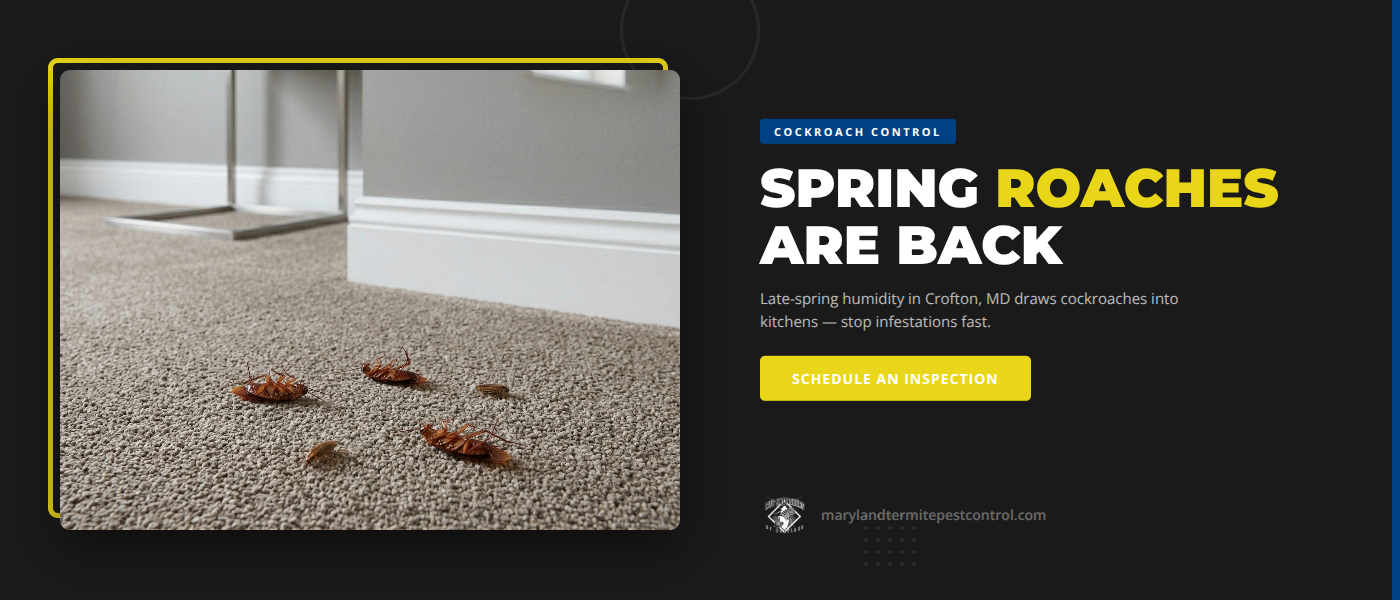
Late spring across Crofton brings the same call every year — "There's a roach in my kitchen, and I have no idea where it came from." Humidity climbs through May and June, storms saturate Anne Arundel County soil, and cockroaches that spent cooler months hidden in wall voids come out hunting for water. At Bug Squashers, we see cockroach control crofton md service requests rise sharply between Mother's Day and the Fourth of July.
The good news for Crofton homeowners: roaches are highly preventable once you understand what's drawing them in. The cockroach control crofton md families need is mostly about cutting moisture, sealing gaps, and spotting early evidence before the population doubles. In this guide, we walk through why late-spring conditions trigger infestations, where roaches hide in Crofton homes, the warning signs to watch for, and the steps that actually work in our climate.
Cockroaches don't disappear in winter — they hide. Across Anne Arundel County, German cockroaches overwinter inside heated buildings while American, Oriental, and wood cockroaches retreat to mulch beds, woodpiles, and wall voids. The trigger that pushes them back into living space is a combination of warmth, moisture, and easy food access.
Three patterns push our cockroach calls up across Crofton every spring:
The result: a pest already present at low numbers becomes suddenly visible to a Crofton family that had no idea it was there.
Cockroaches need water more than food. The University of Maryland Extension's cockroach guidance confirms five species commonly infest Maryland homes — German, Brown-banded, American, Oriental, and Pennsylvania wood — and every one of them is moisture-driven.
In Crofton's late spring, moisture shows up in places that go overlooked the rest of the year:
A German cockroach can survive about a week without food but only a few days without water. Cut the moisture and you remove the single largest reason a cockroach population can sustain itself indoors. We tell every Crofton client we work with that a dry house is a hostile house.
Maryland's humidity also accelerates the breeding cycle. German cockroach egg cases hatch in three to four weeks when conditions are warm and damp, and a single fertilized female can produce thousands of descendants in a year if nothing intervenes. Late-spring conditions are the starting gun for that math.
Roaches are thigmotactic — they prefer tight spaces with surfaces touching their bodies on multiple sides. When we run a cockroach control crofton md inspection, we work through the same sequence in every home, because roaches reuse the same harborage zones across our service area.
Top hiding spots we check first:
Cardboard is a roach magnet. The corrugation provides perfect harborage and the glue is digestible to several species. Crofton households with stacks of cardboard near the laundry room or pantry consistently come up positive on our flushing inspection.
Cockroaches are nocturnal, and a healthy population stays hidden until it's forced out. By the time most Crofton families notice something, the roaches have been there for weeks or months. Here's what we tell clients to watch for:
If you spot two or more of these signs, the population is established. Spot treatment over a single weekend rarely succeeds at that point.
The health concern most Crofton families don't think about is allergens. Cockroach feces, saliva, and shed skin contain proteins that become airborne in dust and can trigger asthma symptoms and allergic reactions. The American Lung Association's cockroach indoor-air guidance links sustained roach exposure to increased asthma morbidity, particularly in children with existing respiratory conditions.
What that looks like in a Crofton home:
Roaches also mechanically transport bacteria. Their bodies pick up E. coli, Salmonella, and Staphylococcus from drains, garbage, and pet-waste areas, and they deposit those organisms on the kitchen counters, plates, and food packaging they walk across at night. This is one of the reasons we treat cockroach calls with the same urgency as a rodent call — the contamination footprint is similar even when the pest is smaller.
The cockroach control crofton md routine that actually works in our climate comes down to five steps. Every Bug Squashers technician walks Crofton clients through this list at the close of treatment:
If you complete steps one through five and still see live roaches within two weeks, the population has reached a size where DIY no longer keeps up. That's when we get the call.
Roach problems escalate quickly. We tell Crofton homeowners to call us when any of the following happens:
Our cockroach control service follows a structured four-step process: a thorough inspection of every harborage zone in the home, targeted treatment using gel baits and EPA-registered residual products, sealing and sanitation guidance, and a follow-up visit at the two-to-three-week mark to confirm elimination and intercept any newly hatched nymphs. Most Crofton homes resolve a localized infestation in one to two visits when caught early; established multi-room infestations typically need three visits across six weeks.
We service residential properties throughout Crofton and across Anne Arundel County, including Gambrills, Odenton, Bowie, Davidsonville, Severn, and Hanover. Whether you've spotted a single roach on a counter or you're already finding droppings in two rooms, we'll match the response to what's actually living in your home.
Cockroaches are nocturnal and forage when the lights go out. A single sighting at night usually means daytime harborage exists within a few feet — typically in a warm appliance compartment, an under-sink cabinet, or a wall void with moisture. Flip a light on around 11 p.m. and check the kitchen sink edges, the back of the stove, and the area behind the trash can.
Three main routes: utility penetrations (gaps around pipes, cable lines, and AC condensate drains), grocery and shipping packaging (especially cardboard and paper bags), and shared walls in apartments and townhomes. American and wood cockroaches also wander in through gaps under garage doors and worn weather-stripping during humid stretches.
Moisture, warmth, and even tiny food residues — a greasy stove coil, a damp dish sponge, or a dripping pipe is enough to support a cockroach population. We've worked Crofton kitchens that look spotless but harbor active roaches behind appliances where condensation, splatter, and dust collect out of sight.
For an early-stage German cockroach issue confined to a single room, gel baits paired with aggressive moisture and sanitation work can clear small populations. Once the issue spans multiple rooms, includes a visible egg-case load, or persists past two weeks of DIY effort, professional treatment is the only consistent path forward.
Initial knockdown typically happens within 7–14 days as bait carries through the harborage. Full elimination — including the next generation hatching from existing egg cases — usually takes four to six weeks across two service visits.
Late-spring humidity is the trigger that turns a hidden cockroach population into a visible problem. The cockroach control crofton md homeowners actually need is a layered routine: cut moisture aggressively, seal entry points, harden food storage, and respond fast at the first warning sign. When the problem outpaces what you can do at home, that's our cue.
If you've spotted roaches, droppings, or a musty odor in your home, contact Bug Squashers — we've helped families across Crofton and Anne Arundel County stop infestations before they spread room to room.